
Mung beans sprout faster in the dark because darkness keeps the hormones that drive early elongation (mainly auxin and gibberellins) elevated, while light exposure quickly suppresses those signals and slows the rapid stretching that pushes a seedling upward. For sprouting purposes, that early dark phase is exactly what you want: quicker germination, longer white shoots, and the pale, crisp texture that makes bean sprouts look and taste the way they're supposed to. For most indoor setups, keeping a covered jar in a dark cabinet at room temperature, rinsing twice a day, gets you harvest-ready sprouts in about 3 to 4 days.
Why Do Mung Beans Grow Better in the Dark and How to Use It
Marcus Hartley
19 May 2026
Why 'dark makes beans grow faster' actually happens
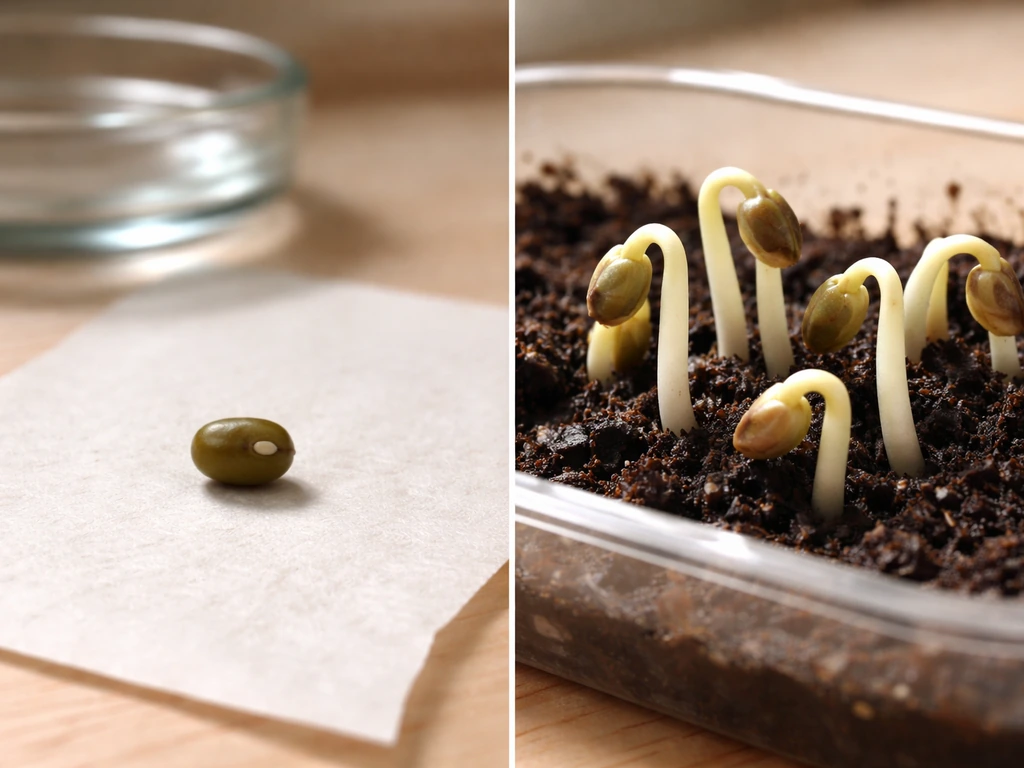
There's an important distinction hiding in this question: we're really talking about two separate stages of a plant's life. Germination is the first phase, where the seed absorbs water and the embryo kicks off cell division. Seedling growth is what comes after, when the young plant pushes a shoot upward and starts developing true leaves. Darkness helps differently at each stage, and mixing them up is where most of the confusion starts.
During germination, mung beans are not doing photosynthesis at all. They're running on energy stored in the seed itself. At this point, light doesn't add energy to the process; it actively interferes with it. Phytochrome receptors in the seed tissue detect light and send signals that can slow the elongation of the hypocotyl (the shoot below the seed leaves). Keep the light off and those elongation signals stay strong.
Once a seedling emerges and reaches light, it goes through a process called de-etiolation. Rapid shoot elongation slows down, chlorophyll production kicks in, and the plant starts building the machinery for photosynthesis. That transition is great for long-term health, but it puts the brakes on the fast, stretchy growth you see in a sprout jar. So when people say 'my beans grew faster in the dark,' they're usually measuring shoot length during germination, not overall plant vigor weeks later. Those are two very different things.
What darkness actually does inside the bean
The core mechanism comes down to hormones. In dark-grown mung bean seedlings, auxin (IAA) levels stay elevated. Research on mung bean hypocotyls found that tissue exposed to light for 48 hours had about 37% less IAA than dark-grown tissue. Less auxin means less cell elongation, which means shorter shoots.
The same tissue also produces ethylene in response to brassinosteroids, a class of hormones that promote growth. Even brief light exposure starts suppressing that ethylene production fast: around a 35% drop after just 15 minutes of light, and up to 75% after an hour.
The Penn State pure. psu. edu record on brassinosteroid-induced ethylene reports that using 4-day-old dark-grown mung bean seedlings, brief handling light decreases the BR-triggered ethylene response, matching this rapid light suppression [brief light exposure starts suppressing ethylene production fast](https://www. pure.
psu. edu/en/publications/light-inhibition-of-brassinosteroid-induced-ethylene-production/). That's a significant hormonal brake being applied almost immediately.
Gibberellins (GAs) are part of this story too. Light, perceived through phytochrome receptors, regulates GA biosynthesis gene expression. When phytochrome detects light, it suppresses certain GA pathways that would otherwise drive elongation. In darkness, those pathways stay open. Phytochrome regulation of gibberellins is well-documented in germinating seeds, including Vigna species closely related to mung beans. The upshot: a dark environment keeps a kind of hormonal 'grow fast' mode switched on during that early sprouting window.
There's also a stress-response angle that's easy to overlook. In nature, a germinating seed underground is in darkness and warmth. The rapid elongation drive is essentially the seedling's push to reach the soil surface before it runs out of stored energy. That urgency is baked into the biology. Darkness mimics being underground, so the plant pushes hard. Light tells it 'you made it out,' and it shifts resources toward photomorphogenesis instead of rapid elongation.
Step-by-step: setting up mung beans to sprout in the dark
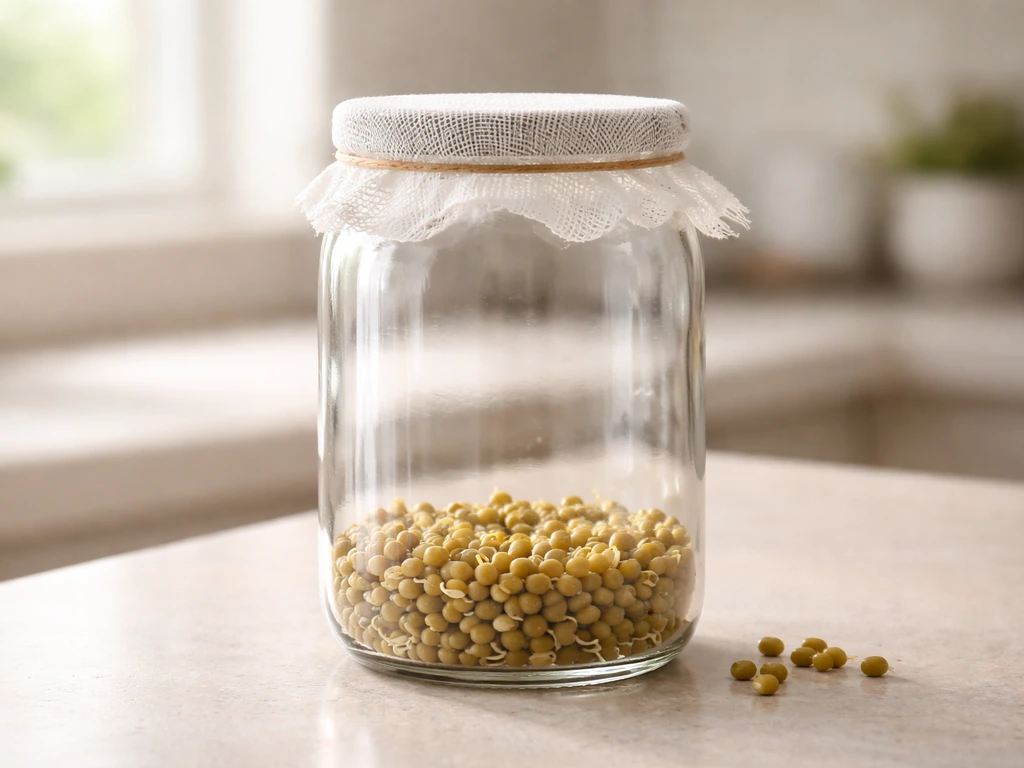
This is the method that works consistently at home, based on established extension guidance and what I've found actually holds up in a small apartment kitchen.
- Start with a clean jar (at least 1-quart) with a mesh or cheesecloth lid that drains freely. Sanitize it before use.
- Measure out about 2 tablespoons of dried mung beans. They expand a lot, so don't overload the jar.
- Soak the beans in cool water for 8 to 10 hours (overnight works fine). This initial soak kicks off imbibition and gets germination started.
- Drain and rinse thoroughly, then tilt the jar at a 45-degree angle in a bowl or dish rack so water can drain and air can circulate. This is critical for preventing mold.
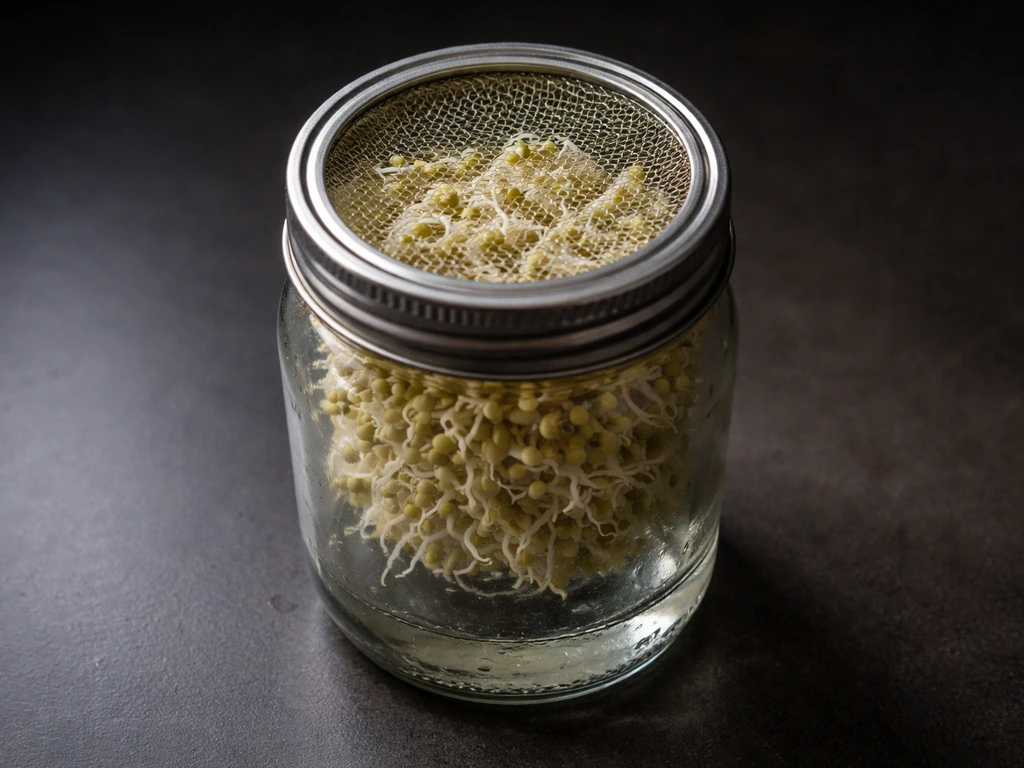
- Place the jar in a dark cabinet, a cupboard, or wrap it loosely in a cloth. You want darkness and a stable room temperature, ideally between 65 and 75°F (18–24°C). Avoid spots above appliances that generate heat.
- Rinse the beans with cool water and drain completely twice a day, every day. Do not skip the drainage step or let water pool in the jar.
- By day 3 or 4, sprouts should be roughly 1 to 2 inches long with white shoots and pale yellow-green tips. At that point they're ready to eat as sprouts.
That whole cycle, from dry bean to harvest-ready sprout, takes 3 to 4 days at room temperature. The sprouts should look etiolated: white or very pale, with no significant greening. That's the visual cue that they developed in proper darkness and with appropriate moisture, which is exactly what you want for classic mung bean sprouts.
The problems people run into (and how to avoid them)
Mold is the most common issue, and it almost always comes down to drainage. If water sits at the bottom of the jar, or if the beans are packed too tightly, you get the warm, wet, airless conditions that mold and bacteria love. Warm, humid sprouting conditions that support sprout growth are equally good conditions for food-contaminating microbes, which is why rinsing frequency and complete drainage aren't optional steps. Two rinses per day, full drainage every time, and a jar that's tilted to drain between rinses handles most of this.
Rot is a related problem but usually signals the temperature is too warm. Above about 75–78°F the sprouting environment gets risky. If your cabinet is above the oven or in a warm corner of the kitchen, move the jar somewhere cooler.
Etiolated, weak-looking sprouts at the seedling stage (if you're trying to grow plants rather than harvest sprouts) are a sign that the dark period lasted too long. Pale, spindly, floppy shoots that never saw light are a problem, but for sprout production they're normal and desirable. The confusion happens when people try to grow mung bean plants from a sprouting setup and wonder why their seedlings look so weak. The answer is simple: sprouts and seedlings are being grown for different goals, and the dark setup is optimized for sprouts, not long-term plant health.
Misreading what 'faster' means is also common. If you compare a dark-sprouted mung bean at day 4 with a light-exposed one and the dark bean's shoot is longer, that's shoot elongation, not necessarily better plant development overall. In general, you get better sprouting growth in the dark during germination, while light is what kicks off the next stage of normal seedling development. If your goal is to grow mung beans as plants rather than eat them as sprouts, that early dark-driven length doesn't translate to a healthier or more productive plant. It's a temporary effect tied to the etiolation response.
When to bring in light, and what kind to use
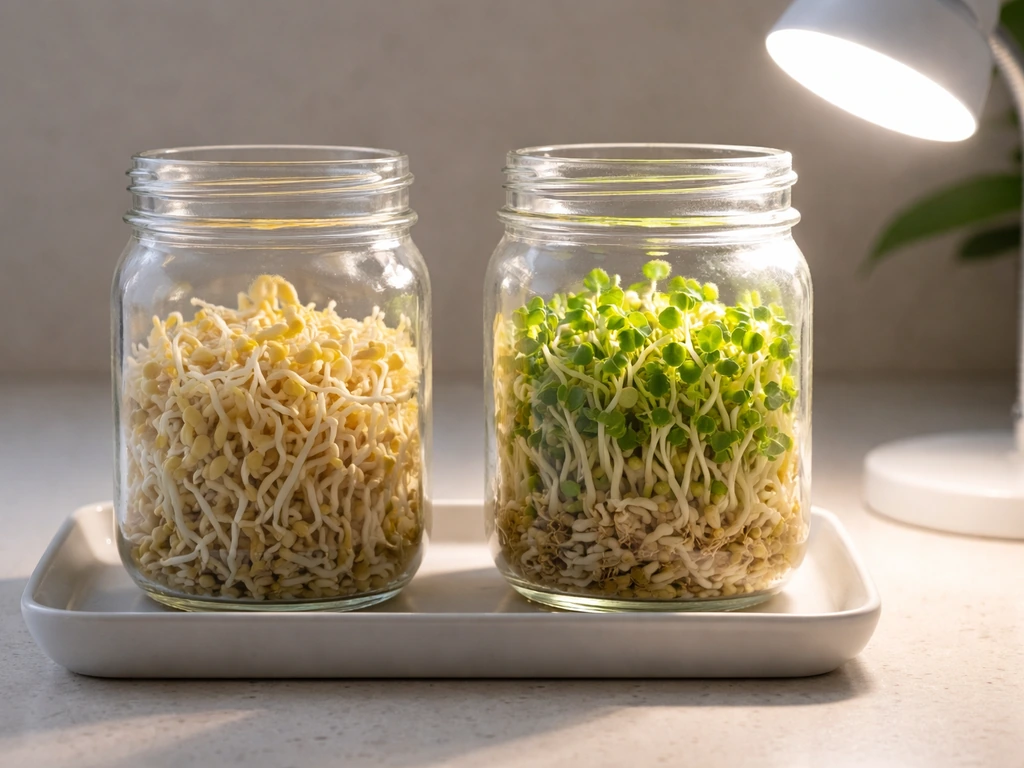
If you're growing sprouts to eat, you don't move them to light at all. Rinse, drain, harvest. Done. The pale color is a quality marker here, not a deficiency.
If you're growing mung beans as actual plants (for pods, or for seedlings to transplant), you want to introduce light as soon as the shoot has emerged from the seed coat and is standing upright, usually around day 2 to 3. Waiting longer than that risks producing a weak, etiolated seedling that will struggle even after light exposure.
For light source, bright indirect sunlight near a window works fine at first. A south-facing window in a northern hemisphere home typically gives 4 to 6 hours of direct sun, which is more than enough for de-etiolation. If you're in a low-light apartment, a simple LED grow light works well. Full-spectrum LED panels or even a basic 6500K daylight LED bulb 6 to 12 inches above the seedlings for 12 to 14 hours a day handles the transition smoothly.
You don't need anything expensive. The goal at this stage is just to stop the etiolation response and get chlorophyll development going. Once the seedlings have been under light for a few days and you see genuine green leaf color developing, they're through the transition.
How to test and adjust your setup indoors
Consistent results come from controlling a handful of variables. Here's what to check if your sprouts are coming out inconsistent:
| Variable | Target Range / Recommendation | What goes wrong outside range |
|---|---|---|
| Soaking time | 8 to 10 hours in cool water | Under-soaked: slow germination. Over-soaked: mushy seeds, bacterial risk. |
| Temperature | 65 to 75°F (18–24°C) | Too warm: mold, rot, safety risk. Too cool: slow or stalled germination. |
| Rinse frequency | Twice daily | Once or less: mold. More often is fine if fully drained each time. |
| Drainage | Complete, tilted 45° between rinses | Pooled water causes mold and bacterial growth within hours. |
| Airflow | Mesh lid or cheesecloth, not solid lid | Solid lids trap moisture and create anaerobic conditions. |
| Container fill level | No more than 1/4 full of dry beans | Overpacking restricts airflow and drainage, leads to uneven sprouting. |
| Darkness quality | Dark cabinet or covered jar | Frequent light exposure slows elongation and greens the sprouts prematurely. |
| Harvest timing | Day 3 to 4 at ~1–2 inches | Waiting too long produces tougher, more bitter sprouts. |
If you're troubleshooting a specific batch, start with drainage and temperature. Those two variables account for most sprouting failures. If everything looks right but germination is slow, check your seed source: old mung beans with low viability won't sprout reliably no matter what you do with the setup.
Sprouts vs. seedlings, and how mung beans compare to other beans
Mung beans are particularly well-suited to dark sprouting because they germinate quickly, tolerate the warm-and-moist environment well when drainage is managed, and produce the classic long white shoot that holds up well for culinary use. Most other beans (black beans, kidney beans, chickpeas) can be sprouted similarly, but a few differences matter.
- Larger beans like kidney beans and chickpeas take longer to sprout (often 4 to 6 days) and need more water during soaking because of their size.
- Some beans (notably red kidney beans) contain high levels of lectins and should be cooked before eating even as sprouts.
- Lentils and mung beans are among the fastest-sprouting and lowest-risk options for home setups.
- For growing full plants rather than sprouts, the transition to light after germination is the same across bean species: introduce light as soon as the shoot emerges and is upright.
The broader question of whether plants grow better in the dark or light applies differently depending on what you're measuring and at what growth stage. If you’re wondering whether can plants grow in the dark, the answer depends on the stage, since sprouts can elongate without photosynthesis while long-term growth requires light plants grow better in the dark or light.
Germinating seeds (especially those that aren't photoblastic, meaning they don't need light to germinate) generally sprout well or better in darkness. That said, whether seeds grow in darkness depends on the stage: many will germinate without light, but sustained growth and green development require light. But once a plant needs to sustain itself through photosynthesis, light becomes non-negotiable. Mung beans in a sprouting jar are a special case where you're harvesting before that photosynthesis stage matters.
If you're growing them long-term, light is essential.
For indoor gardeners who are curious about these light and dark dynamics more broadly, the same underlying biology (etiolation, hormone signaling, de-etiolation) applies when you're thinking about low-light plants, grow light setups, or seeds started indoors under fluorescent bulbs. Mung bean sprouts are actually a great, fast-turnaround way to watch that biology in action firsthand, which is part of why they're a classic science-fair subject and a genuinely useful kitchen experiment. If you are wondering does a plant need some darkness to grow, this experiment is a clear way to test the effects of light versus darkness on early growth.
FAQ
If mung beans grow better in the dark, should I keep them in the dark until they are fully green?
No. If you plan to eat the sprouts, keep them in complete darkness for the entire sprouting period and harvest at about day 3 to 4. “Greening” means light-driven chlorophyll development, which changes texture and can make sprouts taste more bitter, even if they are still safe if they smell and look normal.
My dark-sprouted sprouts look pale and a bit floppy, how do I know if that is normal or a problem?
For edible sprouts, “weak” or “long” shoots are usually expected from etiolation, so appearance alone is not a safety check. Use the safety checks your article already points to, smell and cleanliness, and discard any batch with sour, off odors, sliminess, or visible fuzz, even if drainage seems good.
What should I change if I keep getting mold even though I rinse twice a day?
If you rinse twice daily and drain fully but still get mold, the next most common causes are jar crowding and bean size or age. Try reducing the starting amount so water can circulate, and use fresh, high-viability beans, because older beans produce more residue and are slower to establish, which can feed microbes.
Between rinses, is it better to fully seal the jar or leave it covered but draining?
Avoid letting sprouts sit in a closed, non-draining container between rinses. Instead, after rinsing, tilt the jar to drain and keep it covered but not sealed airtight. Even a small amount of trapped standing water can push conditions toward mold and bacterial growth.
Can temperature override the dark effect, and make the sprouts fail?
Yes, but not always the way people assume. Very cold conditions can slow germination so much that the beans sit wet longer, increasing contamination risk. Very warm conditions increase microbial activity. Room-temperature range is key, and if your kitchen is cool, consider a stable cabinet location rather than just turning the lights off.
I’m trying to grow mung beans as plants, not sprouts, can I keep them dark longer to make them taller?
If you are growing mung beans as actual seedlings, you should not keep them dark to extend growth. Introduce light once the shoot is upright (around day 2 to 3). Prolonging darkness for seedling production usually results in weak stems that won’t “green up” evenly even after you move them to light.
When exactly should I harvest dark-grown mung bean sprouts for best texture?
Do not harvest based only on length. The most reliable harvest cue for dark sprouting is the pale, crisp look with no significant greening at about day 3 to 4. If you harvest late, the shoots keep developing and may become tougher and more prone to an unpleasant texture.
How can I tell if some of my batch got light accidentally, and does it matter?
A small amount of pale coloration is expected, but any green patches indicate exposure to light at some point. If you see partial greening, it often means the jar wasn’t fully covered or the cabinet door light leaked in. Use a darker location or an opaque cover and keep the schedule consistent.
My mung beans are not sprouting on time in the dark, what is the first thing I should check?
If germination is slow specifically in the dark setup, the biggest leverage point is seed viability. Even with perfect moisture and drainage, old mung beans can fail to sprout. So use fresh beans, and consider soaking time and rinse consistency to help them start quickly.
Should I keep dark conditions longer for more growth, or switch to light sooner?
For edible sprouts, leaving them in darkness after they are ready mainly increases quality risk, not “growth benefit.” For plant seedlings, light exposure is what triggers de-etiolation and chlorophyll development. So the decision is stage-based: harvest sprouts on schedule, and for seedlings switch to light when the shoot emerges.