
Air plants can survive in low light, but they won't really grow there. If your room gets less than about 75 foot-candles of light (a dim corner far from any window), a Tillandsia will hang on for a while but you'll see little to no new growth, no pups, and definitely no blooms. To actually thrive, most air plants want bright indirect light in the 150 to 1,000 foot-candle range. The good news: if your space is genuinely dim, a simple LED grow light fixes this cheaply and quickly. So no, low natural light alone isn't a great long-term plan, but low-light rooms aren't a dealbreaker either.
Can Air Plants Grow in Low Light? Complete Indoor Guide
Marcus Hartley
1 Jun 2026
What 'low light' actually means for air plants indoors
The phrase 'low light' gets thrown around a lot, but it helps to put real numbers to it. The University of Arizona Cooperative Extension defines indoor light levels using foot-candles (fc): low light is roughly 25 to 75 fc, medium is 75 to 150 fc, and high runs from 150 to 1,000 fc. For context, a bright south-facing windowsill on a sunny day can hit 1,000 fc or more, while a desk lamp a few feet away might give you 30 to 50 fc. Most rooms feel fine to human eyes at levels that are actually starving to a plant.
Scientists who study Tillandsia often use a more plant-specific unit called PPFD (photosynthetic photon flux density, measured in micromoles per square meter per second, or μmol/m²/s). The University of Maine Extension houseplant lighting guidance also discusses using PPFD ranges and a PAR/PPFD meter, since PPFD is more directly relevant to plant light needs than lux alone [PPFD (photosynthetic photon flux density)](https://extension. umaine. edu/publications/wp-content/uploads/sites/52/2021/11/2611-Tips-for-Growing-Houseplants.
pdf). Research on Tillandsia usneoides tested plants at roughly 50, 100, and 200 μmol/m²/s. That lowest tier, around 50 μmol/m²/s, is the measurable edge of 'low light' for Tillandsia. Photosynthesis still technically happens there, but barely enough to sustain the plant rather than build new tissue.
You don't need to memorize these numbers, but knowing they exist helps when you're shopping for a grow light or using a measurement app.
Survive vs thrive: what low light actually does to a Tillandsia
Air plants use a photosynthesis pathway called CAM (crassulacean acid metabolism), which is pretty efficient compared to many houseplants. That's part of why they're marketed as low-maintenance and sometimes suggested for dim spaces. CAM does allow some photosynthetic activity at lower light levels, which is why your air plant won't die in a week on a shaded shelf. But research on species like Tillandsia brachycaulos makes clear that reduced light means reduced photosynthesis, reduced transpiration, and ultimately lower biomass, meaning the plant just stops building itself.
Practically, what that looks like in your home is an air plant that stays the same size for months, never produces pups (offsets), and won't bloom. If you are wondering can monsteras grow in low light, keep in mind most plants, like air plants, still need enough light to grow, not just survive. Portland Nursery's guidance on blooming is blunt: give the maximum allowable light, along with water and fertilizer, if you want flowers. A plant coasting on 40 fc in a dim corner is in maintenance mode, not growth mode. Think of it like a phone on 5% battery: it's technically on, but it's not doing much.
Which air plants handle lower light a little better
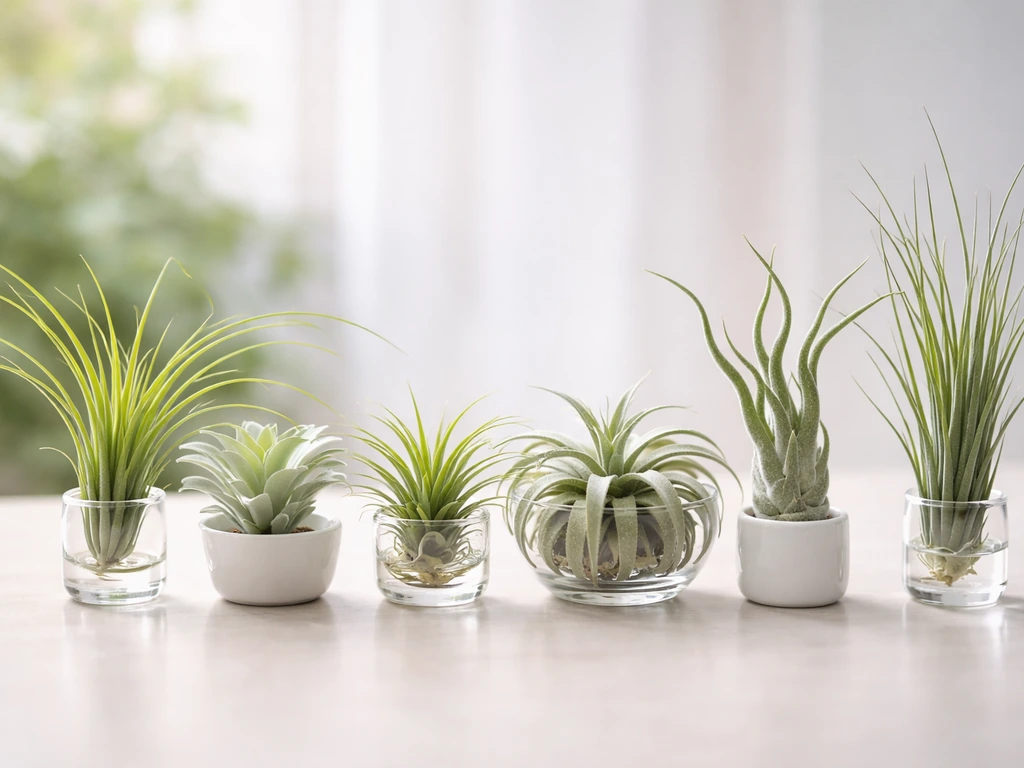
Tillandsias are broadly divided into mesic and xeric types. Mesic varieties (like Tillandsia bulbosa, T. butzii, and T. streptophylla) come from more humid, shadier forest environments and are generally more forgiving of lower light conditions. Xeric types (like T. xerographica and T. tectorum) come from brighter, drier climates and really do need stronger light to stay healthy. If you're working with a genuinely dim space, mesic types are your best starting point, though even they'll eventually suffer without at least moderate indirect light or a grow light supplement.
How to check your room's light level right now
You don't need an expensive lab meter to get a useful light reading. Here are a few quick methods ranked from easiest to most accurate.
- The shadow test: Hold your hand about a foot above a plain piece of white paper. In bright indirect light, you'll see a sharp, clear shadow. In medium light, the shadow is soft but visible. In low light, there's barely a shadow at all. Rough? Yes. But it gives you a real-world gut check in ten seconds.
- A free lux meter app: Smartphone lux apps vary a lot in accuracy. Some are unreliable because the phone's camera sensor isn't calibrated for plant-relevant light wavelengths. They can still give you a rough baseline reading to compare spots in your home.
- Photone app: This app (available for iOS and Android) measures PAR/PPFD and lux using your phone's camera and is better calibrated for plant light than most generic lux apps. It's free to start and gives you readings in foot-candles, lux, or PPFD. It's the closest thing to a real PAR meter without spending money on hardware.
- A dedicated PAR meter or light meter: If you're serious about growing multiple plants under artificial light, a PAR meter (around $30 to $50 for entry-level options) gives you the most reliable PPFD readings. Overkill for a single air plant, but useful if you're building out a grow space.
Once you have a reading, here's the quick guide: under 75 fc (or under 50 μmol/m²/s PPFD), you're in survival territory and should seriously consider a grow light. Hanna Instruments’ lux parameter explains that lux is an illuminance metric and contrasts it with foot-candles, which are both common units for indoor lighting levels blank" rel="noopener noreferrer">lux vs foot-candles. Between 75 and 150 fc, mesic air plants will be okay but won't flourish. Above 150 fc of bright indirect light, most Tillandsias will actually grow.
Signs your air plant isn't getting enough light
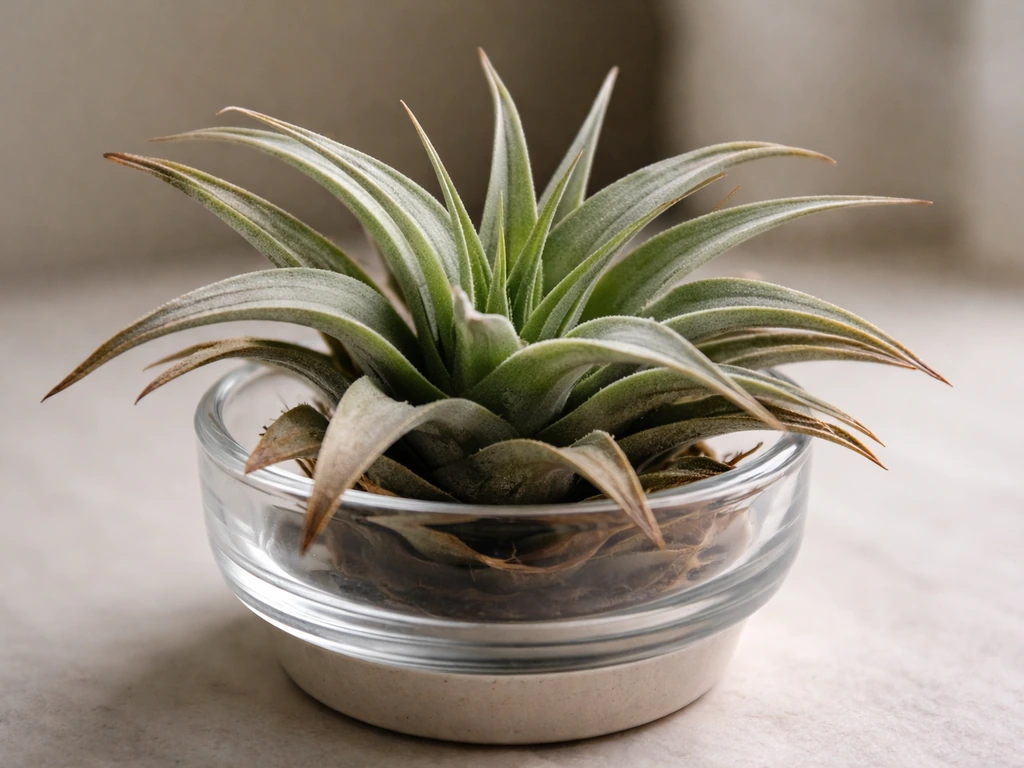
Air plants usually tell you something's wrong before they give up entirely. The tricky part is that some of these symptoms overlap with watering problems, so pay attention to the full picture.
- No growth for several months: Air plants are slow growers, but if yours hasn't changed size at all in three to four months, low light is likely a factor.
- Color fading or dulling: Healthy Tillandsias have vivid silver, green, or sometimes reddish coloration. A washed-out, pale, or yellowing appearance often signals the plant isn't photosynthesizing effectively.
- Leaves feel limp or soft even after watering: Light stress and water stress look similar. If the plant rehydrates and still feels weak, light may be the missing piece.
- No pups after a long time: Pup production happens when a plant is healthy and has energy to reproduce. No pups after a year or more is a flag.
- Brown or crispy leaf tips: This one is tricky because brown tips can also mean low humidity, underwatering, or even fluoride in tap water. But combined with other light-stress signs, it's worth evaluating your light setup.
- Leaves curling inward: Some curling is normal for xeric types, but unusual curling on a mesic variety can indicate stress from low light or inconsistent watering.
If you're seeing browning tips specifically, don't automatically assume it's a light problem. Air Plant Design Studio notes that browning can result from low humidity or insufficient watering, so rule those out before blaming the light. That said, if multiple symptoms show up together, the light level is worth addressing first.
Where to place air plants: windows, distance, and seasons
Window placement is the single biggest variable for natural light. Here's how different exposures play out for air plants in a typical home in the Northern Hemisphere.
| Window Direction | Light Quality | Best for Air Plants? | Notes |
|---|---|---|---|
| South-facing | Brightest, longest duration | Yes, ideal | Keep 1–3 ft back in summer to avoid burning; move closer in winter |
| East-facing | Gentle morning sun | Yes, good for mesic types | Bright but not harsh; safe for sensitive varieties |
| West-facing | Warm afternoon sun | Yes, with some distance | Afternoon light can be intense; 1–2 ft back helps |
| North-facing | Dim, indirect only | Marginal at best | Supplement with a grow light; xeric types won't do well here |
Distance from the window matters enormously. Light intensity drops off fast as you move away from a window. A spot right on a south windowsill might read 800 fc, but three feet back it could drop to 150 fc, and six feet back you might be at 50 fc or less. This is why 'near a window' means very different things depending on the actual distance.
Seasons shift the math too. In winter, even a south-facing window in a northern climate delivers significantly less light than in summer, both because the sun is lower in the sky and because days are shorter. If your air plant does fine in summer but starts looking stressed by January, reduced light is probably why. Hawaiian Botanicals' growing guide specifically connects winter care adjustments to these seasonal light drops. Moving plants closer to the window by even a foot or two can help in the colder months.
Using artificial light to fill the gap in dim rooms
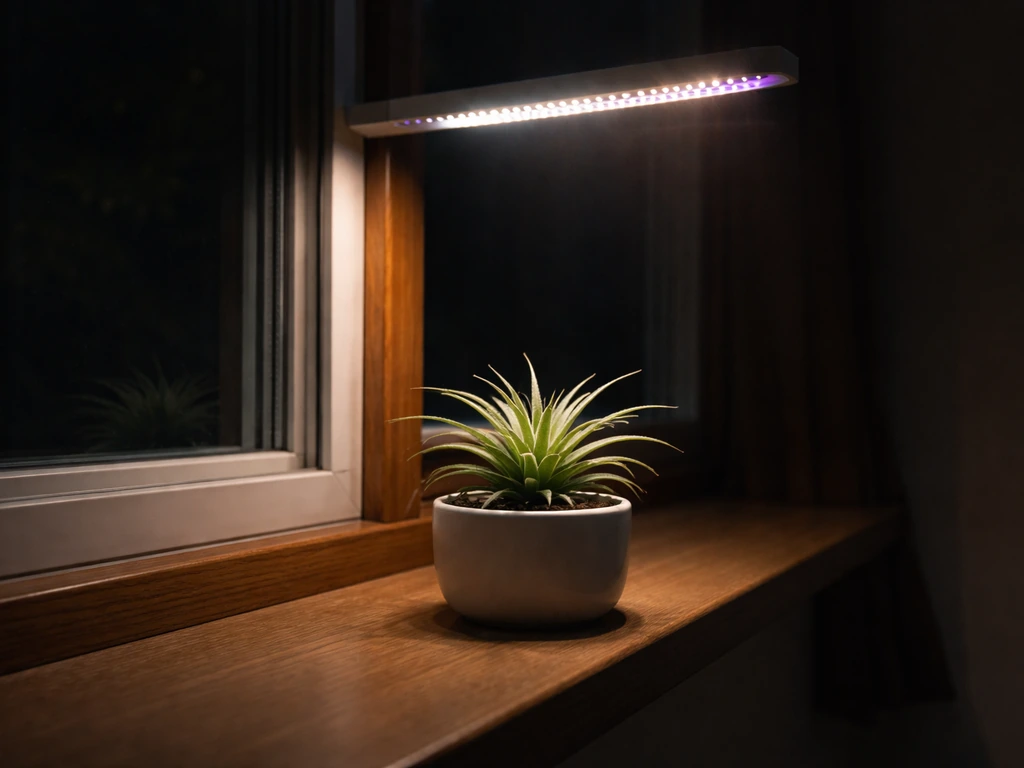
If your natural light genuinely falls into the 'survival zone' and you want your air plants to actually grow, a grow light is the most direct fix. You can also use the same kind of artificial light setup to keep a monstera growing, even when natural light is limited grow light. The good news is that air plants don't need an expensive high-powered setup. They're small plants with modest light appetites compared to, say, fruiting vegetables.
LED grow lights vs fluorescent plant bulbs
| Type | Energy Efficiency | Heat Output | Lifespan | Best Use Case |
|---|---|---|---|---|
| Full-spectrum LED grow light | High | Low | 25,000–50,000 hrs | Best overall choice; run at lower intensity for air plants |
| Fluorescent T5/T8 tubes | Moderate | Low to moderate | 10,000–20,000 hrs | Good for shelves with multiple plants; slightly bulkier setup |
| Standard LED plant bulb (screw-in) | Moderate | Very low | 15,000–25,000 hrs | Easiest to add to existing lamps; fine for one or two air plants |
For most people with a few air plants in a dim room, a simple full-spectrum LED grow bulb in a clamp lamp or desk lamp is all you need. You're not trying to hit the high end of the light scale, just get into that 100 to 200 μmol/m²/s PPFD range that Tillandsia research shows as the useful working zone.
Simple rules for positioning and timing your grow light
- Distance: Most full-spectrum LED grow bulbs work well for air plants at 6 to 18 inches away. LEDs don't generate much heat, so you can go closer than you'd expect without burning. Check with your hand: if it feels warm after 30 seconds, back off a few inches.
- Hours per day: 10 to 14 hours of artificial light per day is the target for air plants under grow lights. This mimics a natural long day and supports active photosynthesis without stressing the plant. Set a timer rather than trying to remember.
- Don't run it 24/7: Plants need a dark period. Running lights around the clock can disrupt their natural cycles and doesn't improve growth. More hours beyond 14 to 16 gives diminishing returns and can stress some varieties.
- Measure with Photone if you're unsure: If you've set up a grow light and aren't sure if it's hitting the right range, the Photone app (in grow light mode) will give you a PPFD reading at the plant's position. Aim for 100 to 200 μmol/m²/s for most mesic types.
- Consistency matters: Erratic light schedules, like leaving lights on for two days then off for a day, are worse than a steady moderate routine. Set a timer and leave it alone.
How to adjust air plant care when light is limited
One mistake people make when they notice their air plant struggling is to water it more, thinking the plant must be thirsty. But when light is low, the plant's metabolism slows down and it uses water much more slowly. Overwatering in low light is one of the fastest ways to kill an air plant through rot. Logee's Tillandsia care guidance is clear that roots must never sit in water, and Moana Nursery's care sheet emphasizes that air plants must dry completely within four hours of watering. In a low-light, low-airflow room, that drying time gets longer, which raises the rot risk.
Here's how to shift your care routine when light is limited, whether you're supplementing with a grow light or working with marginal natural light.
- Water less frequently: In low light, a mesic air plant that normally gets soaked twice a week might only need once a week. Watch the plant rather than the calendar. If leaves still feel soft and supple, hold off on watering.
- Prioritize drying: After any watering or misting, shake off excess water and place the plant upside down for an hour or tilt it so water drains from the base. Good airflow is non-negotiable. A small fan nearby helps a lot in still, dim rooms.
- Don't over-fertilize: Fertilizing makes sense when a plant is actively growing. In very low light with slow metabolism, heavy fertilizing won't speed things up and can cause salt buildup. If you fertilize at all, use a diluted bromeliad or orchid fertilizer once a month at most.
- Keep humidity reasonable but not excessive: Logee's recommends aiming for 50% or higher humidity for Tillandsia. In a dim room, you don't want to push humidity much higher than that, because excess moisture combined with poor light and slow drying is a recipe for fungal issues.
- Increase airflow instead of increasing misting: If you're worried about dryness in a dim space, better airflow does more good than more misting. A small fan on low, running intermittently, keeps moisture from sitting on leaves and helps the plant dry properly.
Troubleshooting and next steps: a simple decision plan
If you're standing in your room right now wondering what to actually do, here's a simple path forward.
- Measure your light first: Use the Photone app or a lux meter app to get a rough reading where you want to place your air plant. If it's under 75 fc or under 50 μmol/m²/s PPFD, that spot won't sustain healthy air plants long-term without supplemental light.
- If you're near a window, optimize placement: Move the plant as close to the brightest window in your home as possible without putting it in harsh direct midday sun. East or west windows are often safer than a harsh south window in summer.
- If the reading is still too low, add a grow light: A simple full-spectrum LED bulb in a clamp lamp costs $15 to $30 and fixes the problem. Set a timer for 12 to 14 hours a day, position the light 8 to 12 inches away, and check the plant's response over two to four weeks.
- Reassess your watering schedule: If you've been watering on the same schedule as before, back off. Low light means slower drying and slower metabolism. Water only when the leaves start to look slightly more dry or wrinkled than usual.
- Watch for improvement over 4 to 6 weeks: With better light, you should see the plant's color become more vibrant, leaves firm up after watering, and eventually new growth at the base or tips. If you see these signs, you've solved the problem.
- If symptoms persist despite adequate light, check for other issues: Brown tips with adequate light often point to low humidity, fluoride-heavy tap water, or root rot from overwatering. Treat these separately. Sometimes a struggling air plant has more than one thing going wrong at once.
- Choose the right plant for the space long-term: If a spot is truly dim and you don't want to run a grow light indefinitely, consider a different plant for that location. Sansevierias are excellent in genuinely low-light spaces. Air plants do best with at least moderate indirect light, and it's better to match the plant to the space than to fight your room's conditions forever.
The honest summary is this: air plants are more light-dependent than their 'no soil, no fuss' reputation suggests. They'll hang on in a dim room, but you won't see the growth, color, or blooms that make them rewarding to keep. Can sansevieria grow in low light? It can survive, but slow growth is common without brighter light. With a bright window or a $20 grow light and a timer, low-light rooms stop being a problem. If you're also wondering can Swiss cheese plant grow in low light, the answer depends on how dim your room is and whether you can provide brighter indirect light some of the day. The fix is usually simpler than people expect.
FAQ
If my air plant stays alive in low light, will it still make pups eventually?
Even if an air plant survives, low light usually means it stops making new tissue, so you should not expect new pups for months. If you want pups, target bright indirect light or add a grow light, and keep the plant in the same spot long enough for new growth to appear (often several months).
My air plant has browning, is it always a low-light problem?
Browning can come from several causes, so the quickest check is timing. If browning increases right after extended watering, it points to slow drying and rot risk rather than light. In low light, shorten watering frequency and increase airflow to help it dry completely within a few hours.
Can I use a small LED grow light in a low-light room and expect real growth?
Yes, but placement matters more than bulb type. A grow light too far away can still leave you in survival conditions, so confirm intensity at the plant (using a phone light meter app only as a rough guide). For most cases, use a small full-spectrum LED and position it so the plant receives consistent bright indirect level during the day.
How can I tell if my room is truly low light for an air plant (not just dim to me)?
Do not assume it is “fine” because you can see it clearly. Human eyesight is forgiving, while Tillandsia light needs are strict. If your plant sits in a dim zone, try moving it closer to the brightest window first, then decide whether you still need a grow light.
What watering schedule should I follow for air plants in low light?
Use the same watering rules, but adjust for metabolism. In low light, water less often, and do a dry-time check after each watering. Never let the plant sit with pooled water inside the leaves or in the crevices, since that is where rot starts.
Should I run my air plant grow light continuously or on a timer?
If you rely on a grow light, use a timer and give the plant a regular day length (commonly 8 to 12 hours). Leaving lights on all day can stress some plants, and inconsistent schedules make it harder to stabilize growth.
Are mesic air plants more tolerant of low light than xeric air plants?
Mesic types are more forgiving, but they are not immune. If your space is near the survival range, xeric varieties often decline faster, showing shrinking, dull color, and eventual loss. Start with mesic if you cannot raise light, and treat xeric as a “light upgrade required” plant.
Does window direction matter, or is distance from the window the main factor?
The “distance from the window” rule usually matters more than the direction. A plant three feet from a window can be far below what the same-direction spot would provide right at the sill. Try measuring or at least physically testing by moving the plant 1 to 2 feet closer for a few weeks.
Why does my air plant do worse in winter even though I didn’t change anything?
Seasonal light drops can create a new survival-only period, even if summer was fine. If your plant looks less perky in winter, move it closer to the window and consider adding a grow light during the shortest months.
If I improve light with a grow light, do I still need to adjust airflow in low-light rooms?
Light is the main driver, but low-light rooms also tend to have lower airflow, which can increase rot risk. If you add a grow light, pair it with gentle airflow (like keeping it near a vent or using a small fan on low) to ensure it dries fully between waterings.