
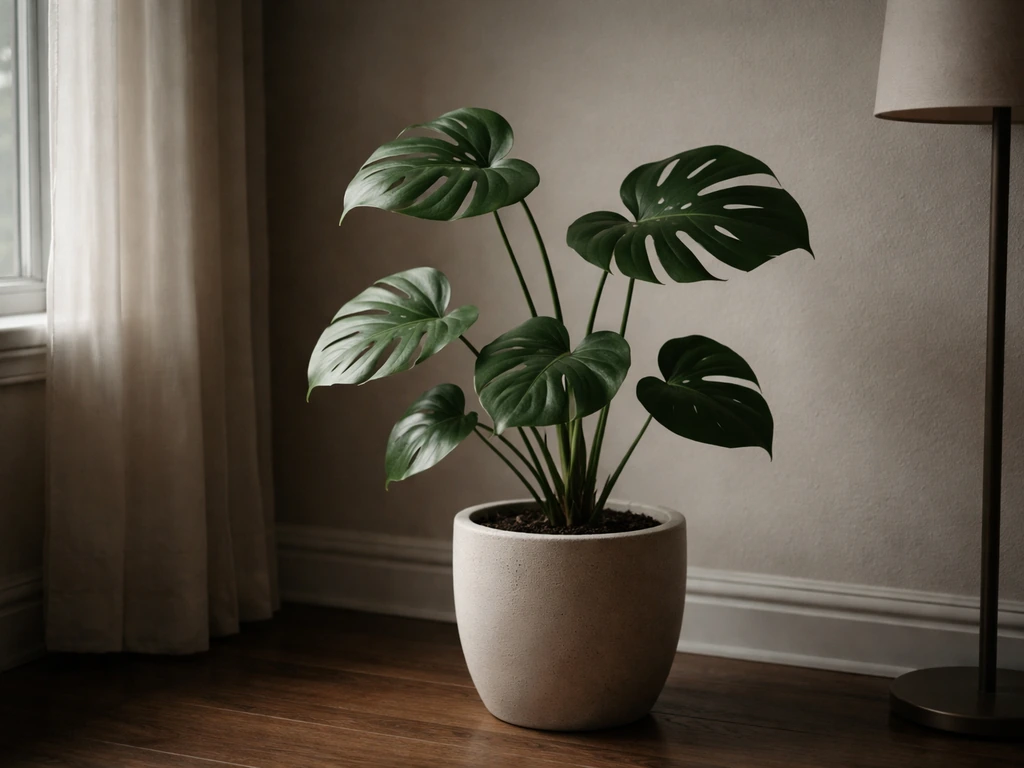
A Swiss cheese plant can survive in low light, but it won't truly thrive there. You'll keep it alive, but expect slow growth, smaller leaves, and almost no fenestrations (those iconic splits and holes). If you're okay with a plant that's just holding on, low light can work short-term. If you want that lush, dramatic look, you'll need bright indirect light or some supplemental grow lighting. Texas A&M AgriLife’s split-leaf philodendron guide recommends bright, filtered light during the active growing period, with direct sunlight in winter.
Can Swiss Cheese Plant Grow in Low Light? Indoor Guide
Marcus Hartley
10 Jun 2026
How Swiss cheese plant light needs actually work
Monstera deliciosa is a tropical understory plant, which sounds like it should love low light. And in the wild, it does grow beneath a forest canopy. But 'forest understory' in the tropics is not the same as a dim corner of your apartment. In nature, Monstera gets dappled, shifting light through a relatively open canopy for hours each day. That's actually closer to what we'd call bright indirect light indoors.
University of Minnesota Extension calls it a good plant for medium-light locations. Penn State Extension recommends placing it near a sunny window where it gets bright but not direct sun. Texas A&M lists bright filtered light during the growing period. Every reputable university extension program puts this plant in the medium-to-bright indirect category, not the low-light category. UF/IFAS explicitly notes it prefers 'medium light,' not low.
So what does 'low light' actually mean indoors? A true low-light spot is typically more than 8 to 10 feet from a window, or a room with only a north-facing window that gets no direct sky exposure. In these conditions, light levels often fall below 50 foot-candles, which is barely enough for most plants to run photosynthesis at a useful rate. A Monstera in that situation is running on fumes. You might also wonder, can air plants grow in low light, and the answer depends on how you can manage light and care.
What to actually expect when you grow it in low light

Here's the honest picture. In genuinely low light, a Swiss cheese plant won't die immediately. It can coast for months, especially in spring and summer. But the growth outcomes are noticeably worse compared to a brighter spot, and they compound over time.
- New leaves come in smaller than older ones, sometimes dramatically so
- Fenestrations slow down or stop completely, leaves come in solid with no splits or holes
- Internodal spacing gets longer (leggy growth) as the plant stretches toward light
- Growth rate drops to nearly zero in winter in low-light rooms
- Petioles grow longer and weaker, making the plant harder to support
- Soil stays wet much longer between waterings, raising the risk of root rot
The fenestration point is worth emphasizing because it's usually the whole reason people buy a Monstera. Those splits and holes develop in response to adequate light and maturity. Without enough light, a mature plant will revert to producing juvenile-looking, solid leaves. I've seen Monsteras in dim hallways that had been growing for two years and still hadn't produced a single split leaf. The plant was alive, but it wasn't doing what it's supposed to do.
Signs your Monstera isn't getting enough light
These are the clearest signals that your plant is light-starved, and most of them show up within a few weeks of being in an inadequate spot.
- Leggy, stretched stems with long gaps between each leaf node
- New leaves that are noticeably smaller than previous growth
- Solid new leaves with no fenestrations, even on a mature plant
- Pale green or yellowing leaves, especially older lower leaves
- Very slow or zero new growth over 6 to 8 weeks
- Soil that stays damp for weeks because the plant isn't metabolizing water efficiently
- The plant leaning heavily toward the nearest light source
If you're seeing two or more of these signs at once, insufficient light is almost certainly the main problem. The first thing to do right now is not to fertilize or repot, it's to move the plant. Get it closer to a window or add a grow light. Everything else is secondary.
Simple fixes before you buy anything
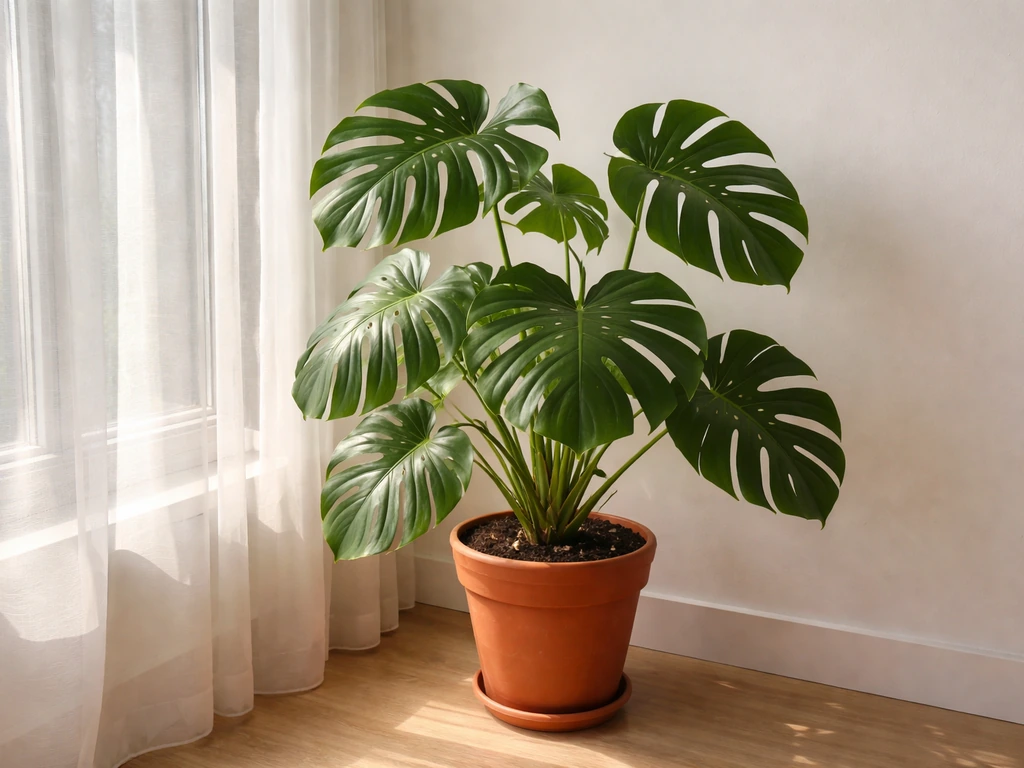
Before spending money on gear, try these adjustments. They cost nothing and often make a real difference.
- Move it closer to your brightest window. A south or west-facing window is best. If you only have a north-facing window, put the plant as close to it as possible, ideally within 3 feet.
- Keep it out of direct afternoon sun in summer, but direct morning sun from an east-facing window is fine and actually helpful.
- Rotate the plant a quarter turn every week or two so all sides get equal light exposure. This prevents one-sided growth and keeps the plant balanced.
- Clean the leaves. Dust on large Monstera leaves genuinely blocks light absorption. Wipe them down with a damp cloth every few weeks.
- Pull back window coverings during the day. Sheer curtains cut light more than most people realize.
Even moving a plant from 6 feet away from a window to 3 feet can double or triple the light it receives. Light intensity drops fast with distance, following what's essentially an inverse-square relationship. Getting physically closer to the window is almost always the highest-impact free move you can make.
Using grow lights in low-light rooms
If your space genuinely can't provide enough natural light, a grow light is the most practical solution and it doesn't have to be expensive or complicated. The two main options for home use are LED grow lights and fluorescent bulbs, and both can work well for a Monstera.
| Light Type | Energy Use | Heat Output | Lifespan | Best For |
|---|---|---|---|---|
| Full-spectrum LED grow light | Low (most efficient) | Very low | 50,000+ hours | Long-term setups, larger plants, energy savings |
| T5 fluorescent grow bulb | Moderate | Low to moderate | 10,000–20,000 hours | Budget setups, smaller plants, starter options |
| Standard LED grow bulb (screw-in) | Low | Very low | 25,000+ hours | Single-plant setups, casual use |
For a Swiss cheese plant, a full-spectrum LED panel or a quality full-spectrum grow bulb in a reflector fixture is the best long-term choice. Look for a light in the 2700K to 6500K color temperature range, or one specifically labeled full-spectrum. Intensity matters more than the exact spectrum: you want at least 200 to 400 foot-candles at plant level for a Monstera to grow decently, and closer to 400 to 800 foot-candles for good fenestration.
For placement, position the grow light 12 to 24 inches above the plant for LED panels, or follow the manufacturer's guidance. Too close and you can bleach the leaves; too far and the intensity drops too much to help. Run the light for 12 to 16 hours per day on a timer. Monsteras don't need darkness to rest, but 12 hours off per 24-hour cycle keeps energy costs down and mimics a natural photoperiod.
If you're comparing artificial lighting options for your Monstera, the same principles apply whether you're growing in a windowless room or supplementing a dim north-facing window. So yes, a Monstera can grow under artificial light if you provide enough intensity and run it long enough can monstera grow in artificial light. The goal is getting measurable light intensity to the plant, not just having a light on in the room.
Care adjustments that matter in low light
Low light changes how your plant uses water and nutrients, so your care routine needs to shift too. Getting this wrong is how people kill otherwise-surviving Monsteras in dim conditions.
Watering
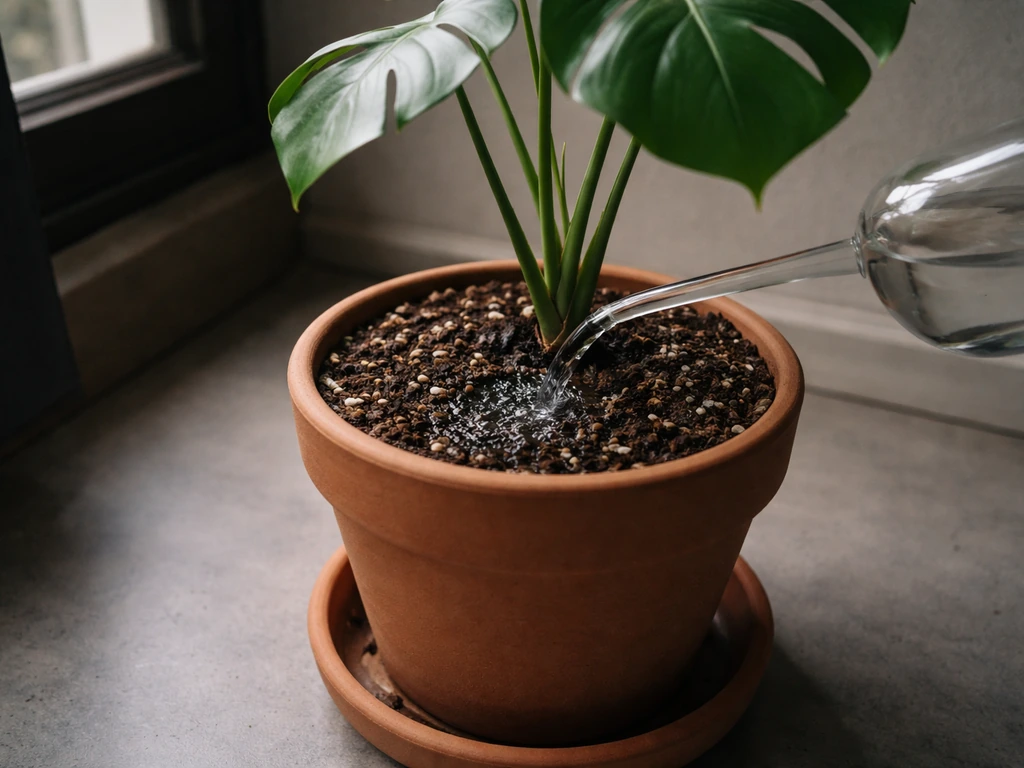
A Monstera in low light uses significantly less water than one in bright light. Its metabolism slows down, it transpires less, and the soil holds moisture much longer. Water only when the top 2 inches of soil are dry, and when in doubt, wait another few days. Overwatering in low light is one of the most common ways this plant dies. Make sure your pot has drainage holes and that water isn't sitting in a saucer.
Soil and drainage
In low-light conditions, use a well-draining mix rather than a standard potting soil that holds a lot of moisture. A mix of potting soil with added perlite (about 20 to 30 percent perlite by volume) keeps roots from sitting in wet conditions for too long. Avoid heavy, peat-dense soils in dim rooms.
Fertilizing
Cut back on fertilizer in low light. A plant that's barely growing doesn't need feeding, and unused fertilizer salts build up in the soil and cause root burn. If you're using a balanced liquid fertilizer, go to half strength and fertilize only once every 6 to 8 weeks during the growing season. Skip it entirely in fall and winter if growth has stopped.
Humidity and temperature
Monsteras like humidity above 40 percent, and while this isn't directly tied to light, dry air in winter can stress a plant that's already light-limited. A small humidifier or pebble tray nearby helps. Keep the plant away from heating vents and drafts, and don't let temperatures drop below 60°F (15°C), which will further slow an already sluggish plant.
When it's time to change your strategy
There's a point where keeping a Monstera in a low-light spot stops being practical, and it's worth being honest about it. If after 3 to 4 months in your current spot the plant has produced no new leaves, the existing leaves are yellowing consistently, or the stems are noticeably elongated and weak, the space isn't working for this plant.
Your options at that point are: move the plant to a better spot in your home, add a dedicated grow light, or swap it out for a plant that genuinely handles low light (Sansevierias, for example, are one of the most reliable true low-light performers, and some pothos and Syngonium varieties also handle dim conditions much better than Monstera does). If you want to grow Anubias in higher light, you can use similar principles by getting enough light for steady rhizome and leaf growth.
Propagation is worth considering too. If your main plant is struggling but has healthy nodes, you can take a cutting, root it, and grow the new plant in a better-lit spot while the parent plant gets moved or repurposed. Monstera cuttings root reliably in water or moist sphagnum moss, and starting fresh in a better location often gets you further faster than nursing a light-starved plant back to health.
The realistic expectation is this: a Swiss cheese plant in a dim room is always going to be a compromise. Sansevieria is often even more forgiving than many houseplants when it comes to low light, so it can be a better match if your space stays dim can sansevieria grow in low light. It won't die on you immediately, but it won't give you what you bought it for either. If you can get it within a few feet of a bright window, even briefly each day, or commit to a decent grow light on a timer, it will reward you with the big, fenestrated leaves it's known for. If neither of those options works for your space right now, a different plant will make you happier and keep you from getting frustrated.
FAQ
If my Swiss cheese plant is already in low light, will it eventually die?
Yes, but you have to treat it like a holding situation. In low light it may survive for months, yet it often produces solid, juvenile leaves and grows slowly. If you bought it specifically for fenestrations, expect little to no splitting until you increase light.
What early signs tell me my Swiss cheese plant is light-starved?
Signs often show up first on new growth. Look for new leaves staying smaller, turning a duller green, and stems getting longer and weaker (stretching). Even if older leaves look fine initially, the ongoing lack of fenestrations usually confirms the light problem.
How can I tell if my room is actually low light, not just a dim window?
Don’t assume “west window” or “north window” by name. Instead, confirm by time and sun exposure: bright indirect light usually means the plant gets strong illumination for hours without direct burning sun. In dim corners, “low light” is common even near windows if nothing hits the plant directly.
Should I fertilize or repot if I suspect low light?
Moving closer is usually higher impact than any fertilizer or pot change. Try relocating first, then reassess in 2 to 4 weeks. If you already moved it and there is still no improvement, that’s when you should add a grow light rather than keep tweaking soil or nutrients.
How should I change watering for a Swiss cheese plant in low light?
Yes, water changes are critical. In low light, let the top 2 inches dry more fully before watering, and use less frequent watering overall. A simple rule of thumb is to never water on a fixed schedule, wait for drying, then empty the saucer if excess drains out.
Can I keep using my normal fertilizer routine in low light?
Low light often leads to overwatering and nutrient buildup, so back off fertilizer. If you’re fertilizing at all, use half strength and only during active growth, roughly every 6 to 8 weeks. Stop entirely if you see little to no new growth, because the plant is not using nutrients.
What’s the fastest way to fix low light with a grow light?
A grow light helps, but timing and intensity matter. Use a timer for 12 to 16 hours daily, and prioritize placement so the plant level receives enough intensity. If you can’t measure, start with a light strong enough and place it relatively close, then adjust if leaves start to look bleached or overly pale.
Will any grow light work, or does it need to be specific?
It can, but very weak light sources like small desk lamps usually won’t help. If the plant level is not receiving enough usable brightness, the plant may stretch and still fail to fenestrate. The goal is adequate intensity at the leaves, not just a light being on in the room.
How do I transition my Swiss cheese plant from low light to brighter light safely?
Avoid sudden changes. If you move from a dim spot to brighter light, do it gradually over 1 to 2 weeks to reduce the risk of leaf scorch. Fenestrations take time, so the payoff is slower than the immediate “no longer stretching” changes.
When is it time to give up on low light and switch plants or locations?
If after about 3 to 4 months there are no new leaves, yellowing continues, or stems are repeatedly stretching and weak, the light level is likely too low for your current setup. At that point, either relocate closer to bright indirect light, add a stronger grow light, or choose a more naturally low-light plant.