
Mint can survive in low light, but it won't thrive. You'll get leggy, weak-flavored stems instead of the bushy, aromatic plant you're imagining. If your space gets fewer than 4 hours of decent light a day or sits in a north-facing room with no supplemental lighting, mint will stretch, pale out, and eventually stall. That said, with a good east-facing window or a basic LED grow light, you can absolutely grow productive mint indoors even in a relatively dim space. The key is knowing exactly where your light situation falls and what to expect from it.
Can Mint Grow in Low Light? Indoor Light Guide
Marcus Hartley
10 Jun 2026
What mint actually needs, and what 'low light' really means
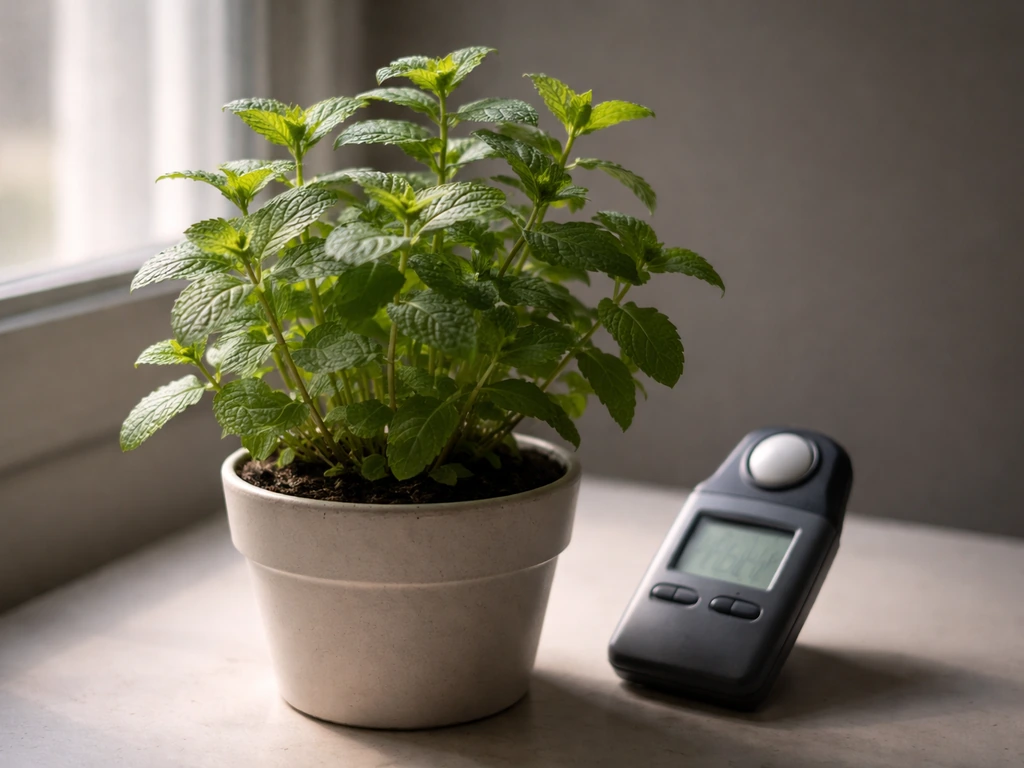
Mint is a Mediterranean-origin herb that naturally grows in bright, open conditions. It wants at least 6 hours of direct or bright indirect light per day to produce the leaf density and essential oils that make it worth growing. In PPFD terms (the measure of plant-usable light hitting a surface per second), herbs like mint sit in the 100–500 PPFD range, with the higher end of that band producing the most vigorous, harvestable growth.
For a practical frame of reference, a bright south-facing windowsill on a sunny day might hit 2,000–5,000 lux, while a typical "low light" interior spot sits around 50–200 lux. University of Minnesota Extension explains that low-light plants require little to no direct light, and that measuring brightness with lumens alone can be misleading compared with plant-usable light [measuring brightness (e. g. , lumens) alone can be misleading](https://extension.
umn. edu/node/19281). Mint starts struggling below about 500 lux for extended periods.
The phrase "low light" gets thrown around loosely, so it's worth pinning down. True low light means a space that receives no direct sun and is fairly dim even during the day: think a north-facing window, a spot several feet back from any window, or a room that relies mostly on overhead room lighting. These conditions are fine for peace lilies and pothos, but mint is not in that category. Mint sits in the medium-to-high light camp for herbs. Understanding that distinction upfront saves you a lot of frustration.
Can mint actually grow in low light? Here's the honest answer
Yes, technically. A string of hearts is another plant that can survive in gentler light than mint, but it still needs enough brightness to keep growth compact and healthy can string of hearts grow in low light. Yes, with supplemental light you can keep mint productive even when natural light is limited can pilea grow in low light. Mint won't immediately die if you put it in a dim corner.
But the plant you end up with will be noticeably different from one grown in adequate light. If you're wondering whether can wandering jew grow in low light, the answer depends on how dim the space really is and whether you can provide supplemental light. If you are planning to try a wandbering jew plant in dim conditions, the same idea applies: low light slows growth and may require supplemental light wandering jew.
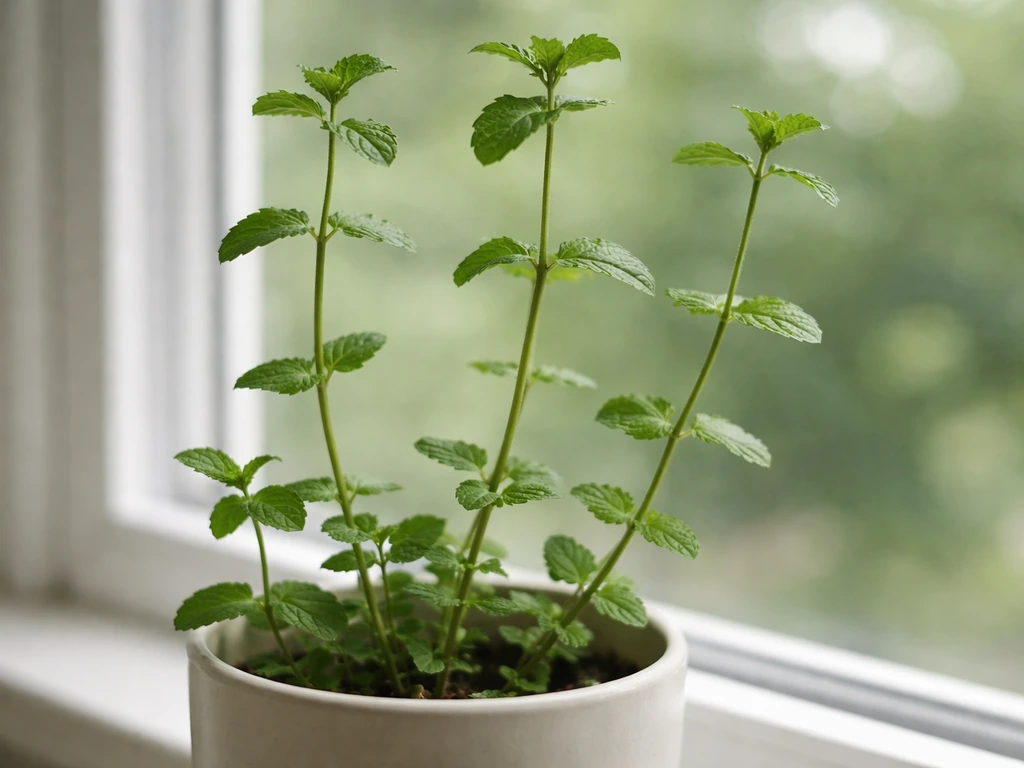
Photosynthesis slows down when there isn't enough usable light, and the plant responds by stretching its stems toward whatever light source exists, spacing out its leaves, and producing far less of the aromatic oils that give mint its flavor and scent. The result is a tall, spindly plant with pale, widely-spaced leaves and a noticeably weak aroma. If you rub a leaf and barely smell anything, that's a low-light plant telling you something.
You can also expect slower recovery after harvesting. Mint in good light bounces back within a week or two after you cut it. In low light, that same plant might take a month to produce new growth worth harvesting, which defeats the whole purpose of growing a kitchen herb. Below about 3–4 hours of bright indirect light or equivalent artificial light, mint growth slows to the point where harvesting regularly becomes nearly impossible without stressing the plant into decline.
The realistic middle ground: a north-facing window with supplemental grow lighting, or a bright east-facing window, will let you keep mint alive and productive at a slower pace. If you want to know whether a bird of paradise can also handle low light, it helps to understand what “low light” means for that plant too. You won't have the same yield as a south-facing sill in full summer sun, but you can absolutely harvest usable, flavorful leaves. That's a workable outcome for most home cooks.
Signs your mint isn't getting enough light
Mint is pretty communicative when it's unhappy with light. Watch for these specific signs, especially in the first 2–3 weeks after moving a plant to a new spot.
- Leggy, elongated stems with long gaps between leaf nodes — the plant is reaching for light
- Pale green or yellowish new growth, especially at the tips
- Smaller leaves than usual, even on established plants
- Weak or barely-there aroma when you crush a leaf
- Slow or no new growth after a harvest
- Leaf drop from the lower stems as the plant abandons older growth
- A general "floppy" appearance where stems can't hold themselves upright
To confirm it's a light issue rather than watering or nutrient problems, do a quick practical check. Hold your hand about a foot above the pot around midday on a bright day. If you can barely see a shadow, or the shadow is very faint and blurry, light levels are too low. Compare that spot to standing near a bright window: the difference is dramatic and immediate. Then watch the plant for 1–2 weeks. If new stems are longer and thinner than older ones, light is the limiting factor. Rotate the pot every few days to prevent it from leaning hard toward the nearest light source.
The best practical light setups for growing mint indoors
Working with natural window light
Window direction matters more than most people realize. East-facing windows are genuinely excellent for mint and most indoor herbs: they deliver direct morning sun that's bright but not scorching, typically lasting from sunrise until around midday. That morning light is consistent and surprisingly intense, and it keeps leaf temperatures from getting too high in summer. South-facing windows get the most total light through the day and are ideal if you have them. West-facing windows work reasonably well, giving afternoon direct sun. North-facing windows alone are almost always insufficient for mint without supplemental lighting, they provide diffuse ambient light but rarely deliver the intensity mint needs to produce well.
Placement within the window matters too. Sitting the pot directly on the sill or within 12 inches of the glass gives you dramatically more light than placing it even 3 feet back. Light intensity drops off fast as you move away from a window, often falling to a fraction of sill-level brightness just a few feet into the room. If you don't have a south or east window, position mint as close to any available window as physically possible before reaching for supplemental lighting.
Using grow lights to bridge the gap
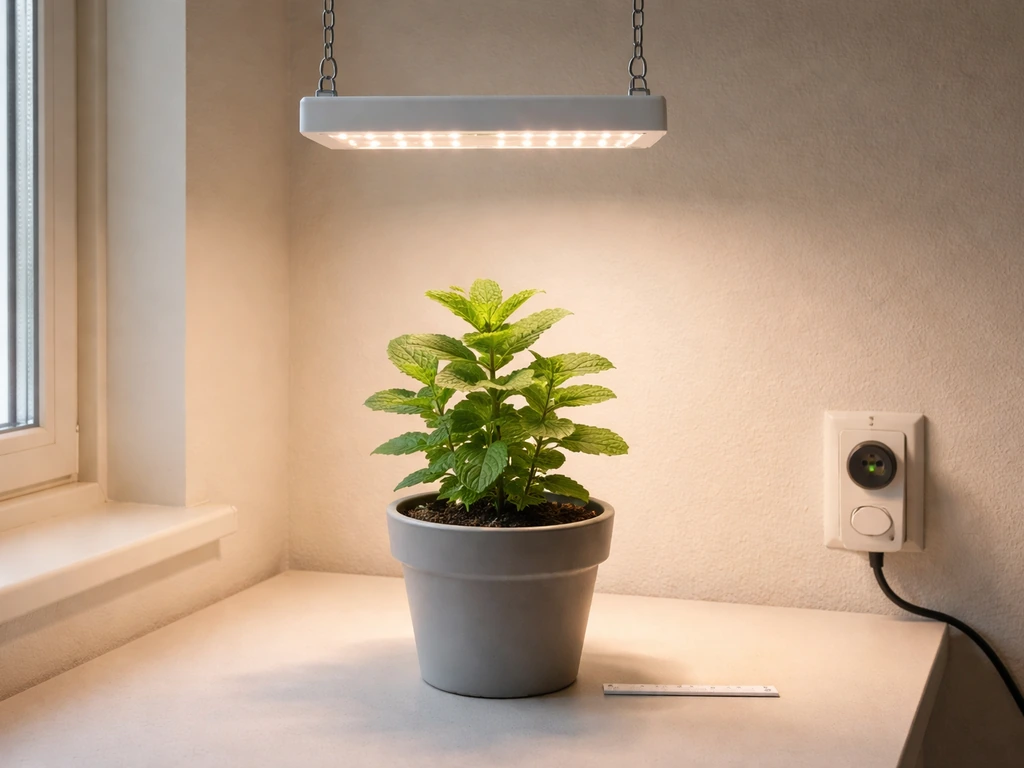
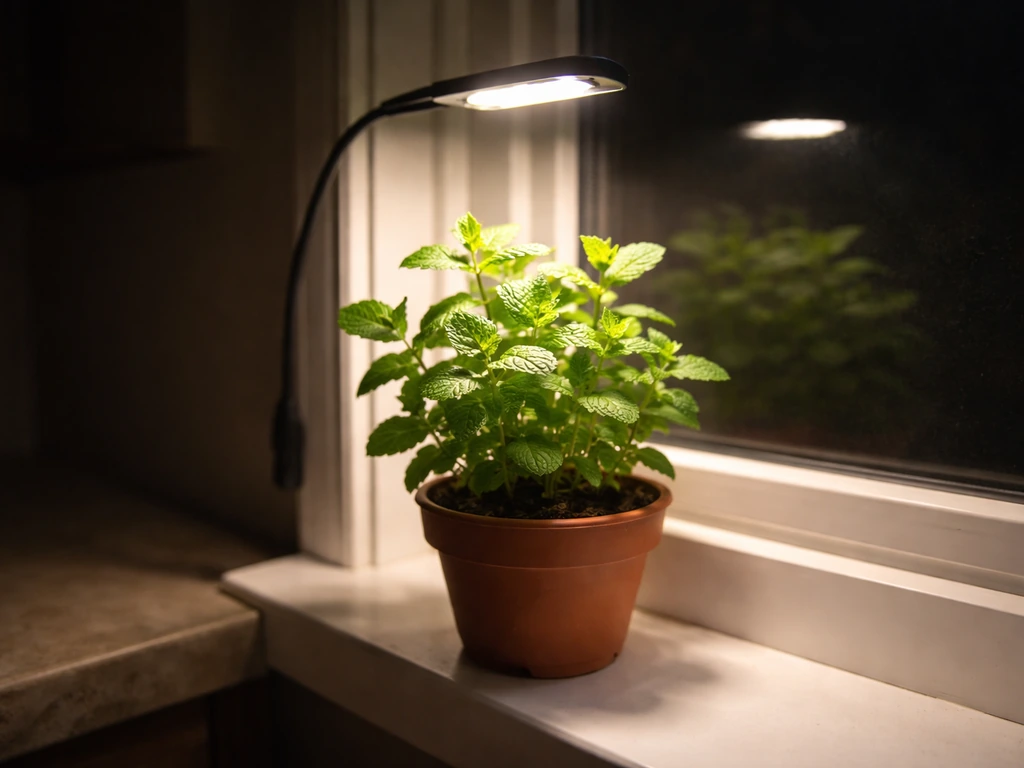
This is where low-light spaces become genuinely workable for mint. A decent LED grow light placed 6–12 inches above the plant and run for 14–16 hours a day can fully substitute for a bright window. Full-spectrum LEDs are the most practical and energy-efficient option right now: they produce the red and blue wavelengths chlorophyll uses most efficiently, they run cool enough to keep close to the plant, and the bulbs last for years. You don't need an expensive setup, a clip-on full-spectrum LED panel in the $25–50 range is enough to keep a pot or two of mint productive.
Fluorescent tubes (especially T5 grow bulbs) are another solid option, particularly if you already have a shop light fixture. They're less energy-efficient than LEDs but still effective for herbs. Keep fluorescent tubes within 4–6 inches of the canopy for best results, since their light intensity drops off quickly with distance. The biggest mistake people make with any grow light is placing it too far away: a light that's 24 inches above the plant delivers a fraction of the photosynthetically active light compared to one at 8 inches. Closer is almost always better for herbs, as long as you're not generating excessive heat.
| Light Source | Best For | Placement | Daily Duration | Cost to Start |
|---|---|---|---|---|
| East-facing window | Best natural option, good morning light | On the sill or within 12 inches | Natural daylight hours | Free |
| South-facing window | Maximum natural light year-round | On the sill | Natural daylight hours | Free |
| North-facing window alone | Not sufficient for mint | N/A without supplemental light | N/A | Free but inadequate |
| Full-spectrum LED grow light | Best artificial option, energy efficient | 6–12 inches above canopy | 14–16 hours/day | $25–$60 |
| T5 fluorescent grow bulb | Good artificial option, widely available | 4–6 inches above canopy | 14–16 hours/day | $20–$50 |
Care changes that matter when light is low
Light level affects everything downstream in the plant's biology, so the care routine that works for a mint plant in a sunny kitchen window needs adjusting when light is reduced. Getting these details right is often the difference between a plant that limps along and one that stays healthy even in a less-than-ideal spot.
Watering

This is the biggest practical change. Mint in low light photosynthesizes more slowly, which means it uses water more slowly too. The soil stays moist for longer, and overwatering becomes a much more serious risk than it is in bright conditions. Check the top inch of soil before watering: if it's still damp, wait. In low light, a mint plant that you'd normally water every 2 days may only need water every 4–5 days. Consistently soggy soil leads to root rot fast, especially in lower-light, lower-airflow indoor spaces.
Fertilizing
Pull back on fertilizer in low-light conditions. A plant that's growing slowly doesn't need much feeding, and over-fertilizing a light-stressed plant can burn roots or cause a flush of weak, leggy growth. If you normally fertilize every 2 weeks at full dose, switch to once a month at half strength during low-light periods. A balanced liquid fertilizer (something like 10-10-10) works fine. Skip the heavy nitrogen feeds that push leafy growth: fast-growing, underfed tissue in low light is exactly the kind of weak, pale growth you're trying to avoid.
Pruning and harvesting
Regular pinching is important even in low light, possibly more so. When mint starts to stretch, pinching the growing tips redirects the plant's energy into side shoots and keeps it bushier. Snip just above a leaf node, removing the top 1–2 inches of each stem. Don't wait until the plant is fully leggy to do this: cut early and often. That said, never harvest more than about a third of the plant at once when light is limited, since the plant needs leaf surface area to capture whatever light it can. In good light you can be more aggressive; in low light, be gentler and more frequent with small cuts.
Spacing and airflow
Mint in low light tends to stretch and crowd itself, and crowded stems in dim, low-airflow conditions are a fast track to powdery mildew or fungus gnats. Give each plant enough space that leaves aren't overlapping, and don't cluster multiple mint pots together. A small fan running a few hours a day near your indoor herb area makes a real difference in preventing fungal issues, especially in rooms without much air movement. Keep mint away from cold drafts near windows in winter, but gentle air circulation is genuinely helpful.
If mint really won't work in your space, try these herbs instead
Not every space can support mint, even with small adjustments, and that's completely fine. There are several herbs that genuinely tolerate lower light levels and will give you better results than a struggling mint plant. If you're also wondering about another houseplant, can parlour palms grow in low light, the answer depends on how dim your space really is and whether you can supplement light. Can string of pearls grow in low light is another common question, but it depends heavily on how dim the space really is lower light levels. If your space is truly dim and you don't want to invest in grow lighting, these are worth considering.
- Chives: one of the most forgiving culinary herbs for lower light, though still better with a decent window
- Parsley: tolerates partial shade better than most herbs and is useful in the kitchen year-round
- Lemon balm: a mint-family herb that handles lower light somewhat better than true mint while still offering herbal flavor
- Vietnamese coriander (rau ram): a shade-tolerant herb with a citrusy, spicy flavor that's much more forgiving than standard coriander
- Chervil: a delicate herb that actually prefers indirect light and bolts in strong sun, making it rare among culinary herbs
It's worth noting that the herb tolerance question mirrors what comes up across a lot of low-light plant growing. Many shade-tolerant ornamental plants like hoyas or certain trailing plants handle dim conditions gracefully, but most edible, aromatic herbs (mint included) evolved in open, sunny spots. The light requirements for producing flavor and aroma are simply higher than those for survival. If you're building out an indoor garden in a low-light apartment, pairing a grow light with a few mint plants plus some genuinely shade-tolerant ornamentals gives you the best of both worlds without fighting the biology of every plant you own.
Bottom line: mint in low light is a compromise, not a failure. With an east-facing window or a basic LED grow light set at the right distance and duration, you can grow productive, harvestable mint in a space that doesn't get much natural light. Adjust your watering, ease up on fertilizer, and keep pinching those tips. If your space truly can't deliver even that much, shift to a more shade-tolerant herb and save the mint for a sunnier spot or a future setup with better lighting.
FAQ
How can I tell quickly whether my “low light” spot is too dim for mint, before I waste a month?
If you are unsure whether your space is bright enough, measure the light in two ways: (1) do the midday shadow test described in the article (your shadow should be faint), and (2) watch whether new mint leaves stay close together. Mint that keeps shortening its internodes and stays compact is getting enough usable light, while stretched, spaced growth usually means it is still too dim.
Can I gradually acclimate mint to lower light instead of moving it directly to a dim corner?
Yes, but do it carefully. If you move mint from a bright window to a dim corner, increase growth lighting or duration gradually over 7 to 10 days. Sudden drops in light often trigger immediate stretching, and once internodes lengthen it takes longer to correct even if you later improve lighting.
Will mint in low light be more prone to mildew, and what should I change besides the light?
Minimum lighting alone is not always enough, airflow matters. In dim conditions mint grows slower and stays wetter longer, which increases mildew risk. A small fan on a low setting for a few hours daily, plus keeping leaves from touching other stems, reduces fungal problems without drying the pot out too fast.
Can regular indoor lighting (ceiling lights, lamps) replace a grow light for mint in low light?
Do not rely on room temperature lamps or overhead lights. Ordinary indoor lighting is usually not strong enough for herbs that need more usable spectrum and intensity. If you cannot provide a full-spectrum grow light, prioritize an east or south window setup and place the pot as close to the glass as possible.
How many hours per day should I run a grow light for mint in a dim room?
Yes, but the plant still needs a consistent “day.” Use a timer and aim for 14 to 16 hours under LEDs, including in low-light apartments. Letting the light run unpredictably can stress the plant and make stretching worse, even if the total hours seem high.
If I water less in low light, how do I avoid overwatering and fertilizer buildup long-term?
The “watering less” rule depends on how fast the top inch dries, not the calendar. In low light, salts can also build up because slower growth means less uptake, so periodically flush the soil with water (until it drains out) and then let it drain fully.
What is the best harvesting or pinching strategy if mint is already stretching in low light?
Do the first pinch early. If mint begins stretching, pinch the growing tips right away, then keep harvesting small amounts rather than waiting for big cuts. In low light, avoid removing more than about one-third of the plant at a time because mint needs leaf area to capture whatever light is available.
Besides stretching, what signs mean my mint is not getting enough usable light, not just too much or too little water?
Look for weak aroma as an early indicator, but also check leaf color and vigor. Mint grown too dim will often have paler leaves and thinner, longer stems. If the plant is producing small, sparse new growth after a harvest, that points to insufficient light rather than a nutrient deficiency.
Is it realistic to keep mint productive without an east window or grow light, or is survival the best I can hope for?
Not always. Some people can keep mint alive in a dim spot, but “productive” mint usually requires either at least an east-facing window with bright morning sun or supplemental lighting. If you cannot commit to placement and a timer, consider putting mint in a brighter area only during peak light hours and moving it less often.
How do I fine-tune LED distance and duration for mint in low light if I do not know my PPFD?
It can, but most hobby setups do not measure PPFD well enough to be confident. A practical decision aid is distance and intensity consistency: place the LED closer (roughly 6 to 12 inches as in the article) and keep the same schedule. If growth is still leggy after 2 to 3 weeks, adjust by lowering the light or increasing hours before changing fertilizer.