
Pilea peperomioides can survive in low light, but it won't thrive there. You'll get a living plant, not a happy one. Expect slower growth, longer stems between leaves, smaller new leaves, and eventually some fading or yellowing if light stays too dim for too long. Bird of paradise (Strelitzia reginae) generally struggles in true low light and will need brighter light or a grow light to maintain healthy growth. If your room genuinely qualifies as low light, the honest answer is: Pilea will hang on, but you'll need to either find it a better window spot or supplement with a basic grow light to keep it looking good.
Can Pilea Grow in Low Light? Signs, Care, and Grow Light Tips
Marcus Hartley
11 Jun 2026
What 'low light' actually means (and where Pilea fits)
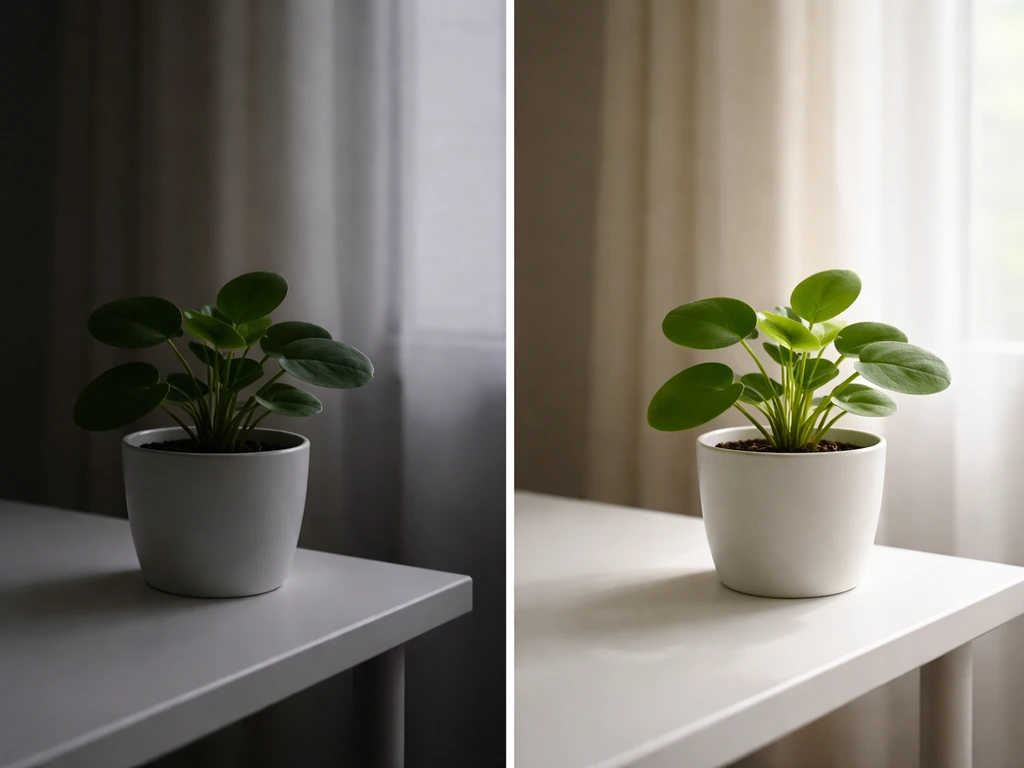
The phrase 'low light' gets thrown around loosely, so let's pin it down. Measured in lux, true low light is roughly 50 to 500 lux. Medium indirect light sits around 500 to 2,500 lux, and the bright indirect range that Pilea actually prefers runs from about 2,500 to 10,000 lux. If you want to know exactly what you're working with, a cheap lux meter (or even a free smartphone app) will tell you fast. A spot that feels reasonably bright to your eyes can easily read under 300 lux, because human vision adapts in ways that fool us about actual light levels.
In PPFD terms (that's micromoles of photons per square meter per second, the unit that matters most for plant growth), around 200 to 300 lux puts most species right near their light compensation point. That's the threshold where a plant is just breaking even between photosynthesis and respiration. At this level, Pilea can keep most of its leaves alive but won't be building much new tissue. True deep shade, like a bookshelf far from any window, can drop to 50 lux or less, and that's where survival gets genuinely questionable.
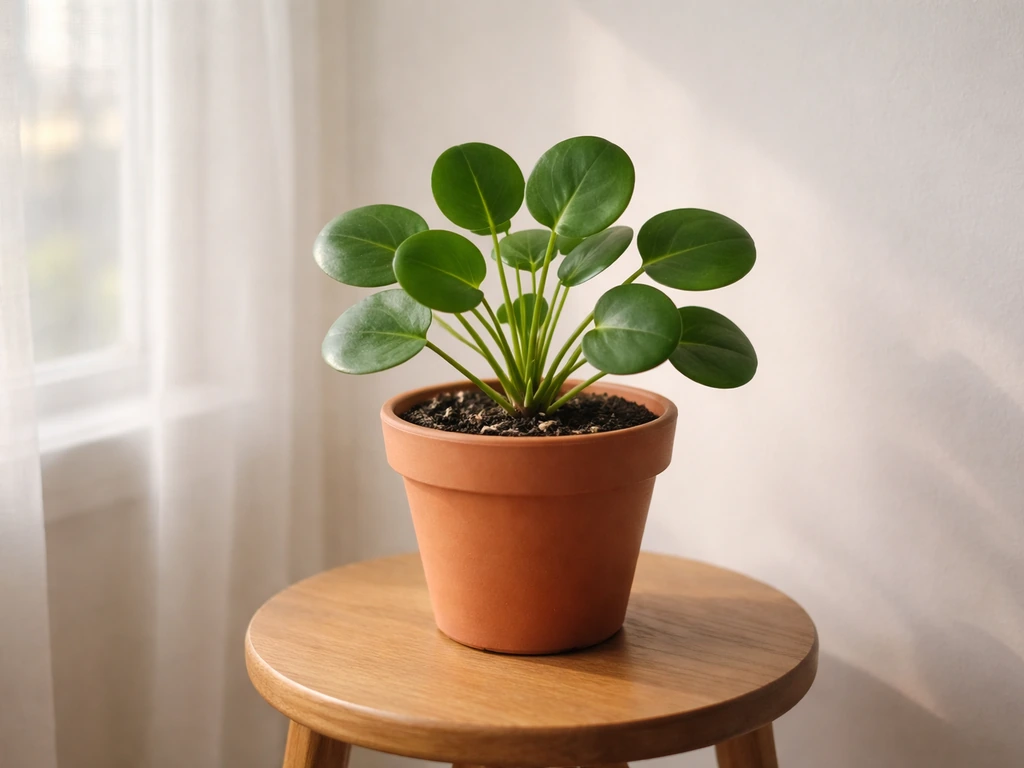
Pilea peperomioides comes from dappled understory conditions in Yunnan, China, so it has some shade tolerance baked in. But 'dappled forest floor' still gets more photons than the average dim apartment corner. The plant is adapted to protected indirect light, not darkness. Think of its natural habitat as medium-to-bright indirect rather than true low light, which means your job in a dim space is to close that gap as much as possible.
What actually happens to Pilea in low light
The most visible symptom is etiolation, which is just the technical word for leggy stretching. When Pilea can't get enough light where it sits, it redirects energy into elongating its stems to search for more. The result is long gaps between leaves, a tall and lanky silhouette instead of that tidy coin-shaped rosette you're going for. It looks like the plant is reaching, because it literally is.
Beyond the leggy look, here's what else you'll notice over weeks or months in genuinely dim conditions:
- Pale or yellowing leaves: Pilea reduces its chlorophyll production when light is insufficient, so leaves fade to a lighter green and eventually yellow. Once a leaf goes fully yellow, it won't green up again.
- Smaller new leaves: New growth that emerges in low light tends to be noticeably smaller than older leaves that developed in better conditions.
- Slower growth overall: The plant is barely hitting its energy budget, so it slows to almost a standstill between spring and autumn.
- Leaning heavily toward the light source: Pilea tracks light more aggressively in dim spaces, so it can become very one-sided if you don't rotate it.
- Increased susceptibility to overwatering: A Pilea using less energy in low light also drinks less water, which means soil stays wet longer and root rot risk goes up.
Making Pilea work in low light: placement, windows, and rotation
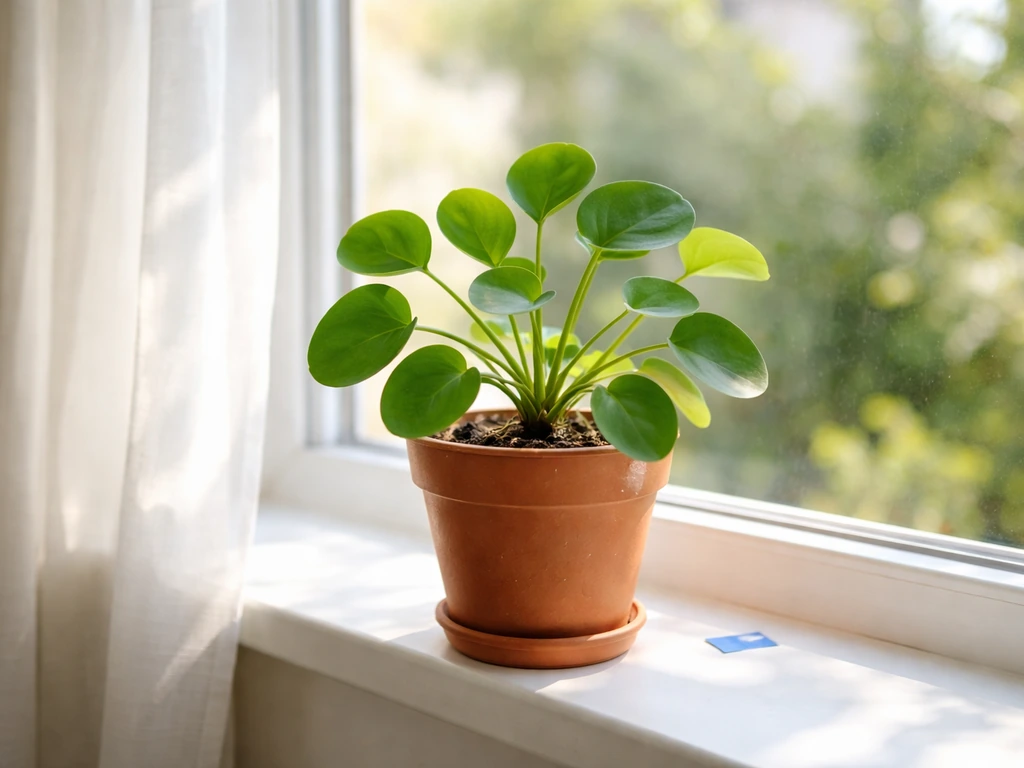
Before you buy a grow light, work the windows you have. The single biggest upgrade most people can make is simply moving the plant closer to the glass. Light intensity drops off sharply with distance, so a few feet can make a real difference. The general rule for low-light apartments: get within about 2 feet of an east-facing window, or as close as practical to a north-facing one.
Window orientation matters a lot here. East-facing windows give gentle morning light, which is ideal for Pilea. North-facing windows are the dimmest but still workable if the plant is right up against the glass. West-facing windows provide afternoon light that can be strong but still manageable for Pilea since it avoids harsh midday sun.
Blooming Expert also recommends placing Pilea peperomioides near an east, north, or west-facing window for bright indirect conditions and to avoid strong direct afternoon sun east-facing, north-facing, or west-facing window. South-facing windows are actually too intense for Pilea without some filtration, like a sheer curtain, to protect it from direct sun scorching the leaves.
If you have a south window, step the plant back a couple of feet or use a thin curtain.
Rotating your Pilea every week or two is non-negotiable in low-light spaces. The plant will lean toward the window aggressively, and without rotation you'll end up with a lopsided plant and uneven growth. A quarter turn every seven to ten days keeps it growing upright and balanced. This is a simple habit that makes a visible difference within a month.
Also consider what's blocking light: dirty windows, overhanging blinds, trees outside, and even nearby furniture can reduce available light more than you'd expect. Cleaning your windows is genuinely one of the easiest free upgrades for any low-light houseplant setup.
Supplementing with artificial light: grow lights for Pilea
If your best window spot still reads under 500 lux, a basic grow light is the practical solution. The good news is that Pilea doesn't need a powerful or expensive setup. A modest LED grow light or a T5 fluorescent strip will do the job.
Choosing between LED and fluorescent
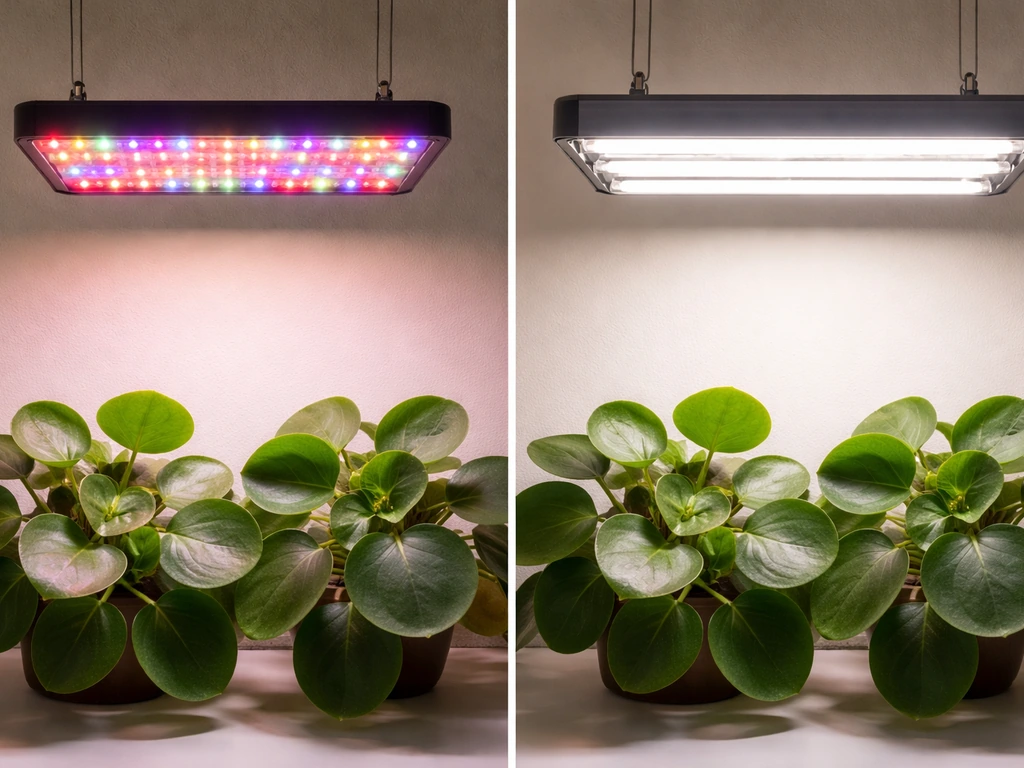
| Feature | LED Grow Light | Fluorescent (T5/CFL) |
|---|---|---|
| Energy use | Low | Moderate |
| Heat output | Low | Moderate |
| Light intensity loss over time | Slow | Faster (bulbs degrade noticeably) |
| Upfront cost | Moderate to higher | Lower |
| Lifespan | Long (50,000+ hours) | Shorter (6,000–20,000 hours) |
| Best for | Long-term, any room size | Budget setups, small spaces |
For most people growing Pilea in a dim apartment, a small full-spectrum LED panel or a simple clip-on LED grow light is the best value. Fluorescent T5 strips are a legitimate budget option, just keep in mind that the bulbs lose output over time and should be replaced every year or so for best results.
Distance, intensity, and how long to run it
For Pilea, you're targeting a PPFD in the range of roughly 100 to 300 µmol/m²/s for low-light recovery, which corresponds to a gentle vegetative growth level. With a low-wattage LED (under 30 watts), keep it around 12 inches from the plant canopy. Higher-wattage LEDs should be placed farther away, anywhere from 18 to 36 inches depending on their output, to avoid bleaching or burning the leaves.
For photoperiod, run the grow light for 12 to 14 hours per day. This mimics a reasonable day length and delivers enough total daily light (what growers call DLI, or Daily Light Integral) for healthy growth without stressing the plant with an unnaturally long photoperiod. A simple plug-in timer makes this completely hands-off. The key insight here is that you can compensate for lower intensity by running the light a bit longer, since what plants actually respond to is the total dose of light over the day, not just the peak intensity.
If you're also relying on a nearby window, the grow light can run as a supplement during daylight hours or extend the light period in the evening. Just don't run it 24 hours straight; plants do need a dark period.
Adjusting care when light is low
This part trips up a lot of plant owners. When Pilea is in low light, it slows down, and a slower plant uses less water and fewer nutrients. If you keep watering and feeding on a 'normal' schedule, you'll almost certainly end up overwatering, which is the fastest way to kill a Pilea.
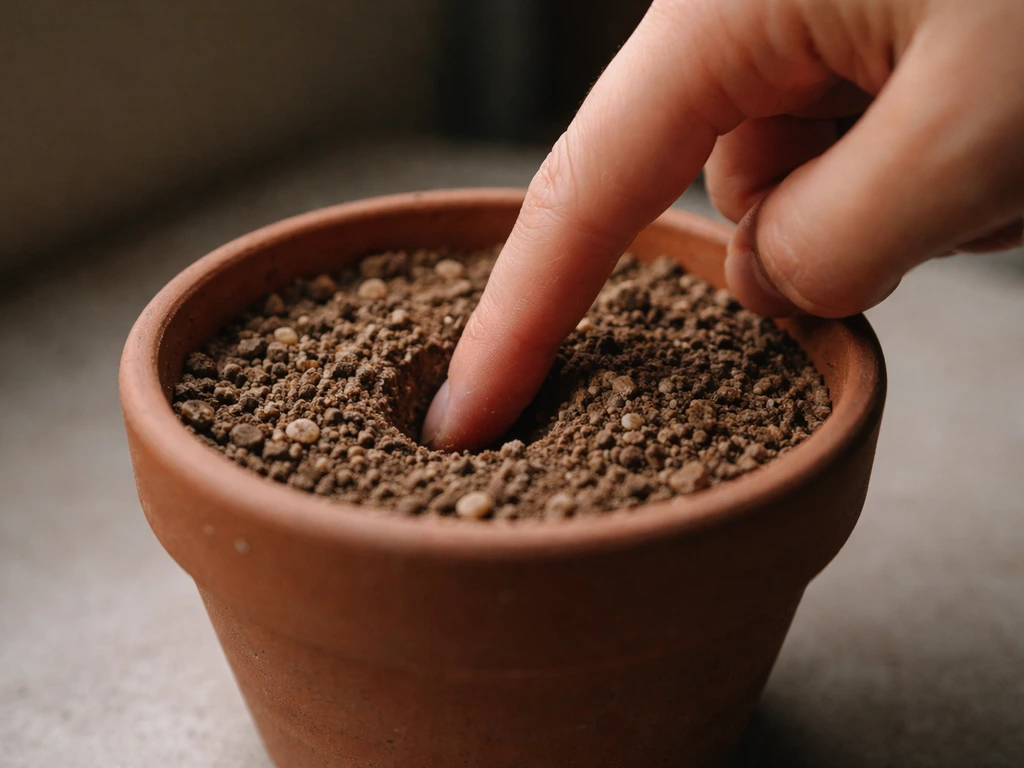
- Watering: Let the top 2 inches of soil dry out completely before watering again. In low light, this could mean watering every 2 to 3 weeks in winter rather than weekly. Stick your finger in the soil every few days rather than following a calendar.
- Soil: Use a well-draining mix with perlite added, around 20 to 30 percent by volume. This prevents water from sitting at the root zone. Avoid dense, heavy potting soils that hold moisture for too long.
- Pot choice: Make sure the pot has drainage holes. A saucer that collects standing water is a root rot setup in slow-growing, low-light conditions, so empty it within an hour of watering.
- Fertilizing: Pull back significantly on feeding. In bright conditions, a balanced liquid fertilizer every 2 to 4 weeks during the growing season makes sense. In low light, fertilize at half strength, once a month at most, and not at all in winter. A plant that isn't growing fast can't use the nutrients, and unused fertilizer salts build up and damage roots.
- Airflow: Give the plant some gentle air circulation, especially if it's in a dim interior room. Good airflow helps prevent fungal issues that are more likely when soil stays damp.
Choosing the right Pilea for a dim space
Most people asking this question have Pilea peperomioides, the pancake plant or Chinese money plant. It's the most popular variety by far, and it's the one that most needs bright indirect light to stay compact and happy. If you're committed to a low-light space, it's worth knowing there are other Pilea species with a slightly different light tolerance. Some growers wonder if a can string of pearls grow in low light, but it has a very different light need than most Pilea.
Pilea cadierei, the aluminum plant, is often listed as more tolerant of lower light conditions compared to peperomioides. It still prefers bright indirect light for best growth, but it copes better in dim rooms and is worth considering if your space is genuinely limited. Other compact Pilea varieties, like the 'Moon Valley' (Pilea mollis) or 'Friendship Plant,' also tend to adapt reasonably well to medium-to-low light.
For variegated or patterned cultivars like Pilea peperomioides 'Mojito,' low light is particularly unkind. The marbling and patterning fades, internodes stretch more noticeably, and the plant loses the visual qualities you bought it for. If you have a variegated Pilea and limited light, the grow light option isn't optional, it's necessary.
Size also matters. Smaller, younger plants stress faster in low light than established ones. If you're starting with a small cutting or a 4-inch pot, prioritize getting it the best light you can while it's establishing. A larger, root-established plant has more stored energy reserves to weather a few weeks of dim conditions during a seasonal adjustment or a move.
Troubleshooting the most common low-light problems
Leggy growth with long gaps between leaves
This is classic etiolation. The plant is stretching toward light. The fix is more light, either closer to a window or a grow light. You can trim leggy stems back to encourage bushier regrowth, and you can propagate the cuttings in water. Don't just pinch leaves off and hope for the best without addressing the light situation, or it'll stretch right back.
Yellowing leaves
Yellow leaves have two main culprits in low-light Pilea: insufficient light and overwatering. If the yellowing is coming from overwatering or root compromise, pilea. com notes that [adjusting watering frequency can help save a Pilea](https://www. pilea.
com/post/how-to-fix-an-overwatered-pilea) that has not fully wilted yet. These two problems often happen together, because low light slows the plant down and overwatering follows. Start by checking the soil moisture before you water again. If the soil is still damp and there's yellowing, hold off on watering and improve drainage.
If the soil is appropriate and yellowing is mainly on newer, smaller leaves, light is likely the bigger factor. Either way, yellow leaves won't recover; you're managing future growth, not reversing existing damage. Trim the yellowed leaves and fix the underlying cause.
No new growth for weeks or months
Stalled growth in low light usually means the plant is at or below its energy break-even point. It's surviving, not growing. Add light first, either reposition near a brighter window or introduce a grow light on a 12 to 14 hour cycle. Once light improves, make sure you're not holding it back with overly wet soil or a pot that's too large (oversized pots hold excess moisture).
Thin, weak stems
Thin or floppy stems alongside slow growth usually signal prolonged low light combined with overwatering. The plant has been in energy deficit long enough that stem tissue itself is underdeveloped. Increase light, let the soil dry out appropriately between waterings, and give it time. Recovery is possible but slow; expect weeks before you see clearly healthier new growth.
When to cut your losses and move the plant
If you've tried the best window, rotated regularly, and added a grow light running 12 to 14 hours a day, and the plant is still stretching and fading, the space is probably just too dark for Pilea long term. At that point, either commit to the grow light as the primary light source (and accept it's part of your room setup) or relocate the plant to a better-lit spot and swap in a more genuinely low-light tolerant species.
Some plants, like parlour palms or certain hoyas, handle dim corners far more gracefully than Pilea does. Parlour palms are generally more forgiving of dim corners than Pilea peperomioides, but they still need enough light to avoid slow decline. Some plants, like parlour palms or certain hoyas, handle dim corners far more gracefully than Pilea does. Knowing that is useful, not defeatist.
The bottom line: Pilea peperomioides can survive in low light, but 'survive' is the ceiling without intervention. Close window placement, regular rotation, and a modest grow light running about 12 hours a day will push it from survival into actual growth. Pair that with adjusted watering habits for a slow-growing plant, and you'll have a genuinely healthy Pilea even in a dim apartment.
FAQ
How can I tell if my room is low light for Pilea, not just “dim looking” to me?
Use a lux meter (or a phone lux app) and take readings at plant height. If it stays consistently under about 500 lux, plan on supplementing. Also watch for behavior: if the plant leans hard toward the window within a week and keeps elongating, the light is likely below what it needs to hold a compact rosette.
Will a window behind a sheer curtain count as low light for Pilea?
It depends on how close the plant is to the glass and how bright the outdoor light is. A sheer curtain often reduces intensity enough that a spot that “feels bright” can land near the 200 to 500 lux range. If you have to rely on that setup, place the plant near the curtain and rotate often, or use a small grow light to stabilize growth.
What’s the safest way to introduce a grow light without shocking my Pilea?
Start with lower daily impact, shorter duration (around 8 to 10 hours) and keep the light slightly farther away than you ultimately plan. Increase to 12 to 14 hours over several days. If you see bleaching or crispy edges, raise the light or reduce runtime, because Pilea can sunburn when intensity ramps quickly.
Can I keep my Pilea under a grow light 24/7?
No. Pilea still needs a dark period, even if it is in dim light. Aim for about 12 to 14 hours on, 8 to 12 hours off. Constant light can stress plants and often worsens issues like soft, weak growth and irregular watering patterns.
How do I know if my grow light is too far away or too weak?
If new leaves are smaller and stem gaps keep increasing after 2 to 4 weeks, the light dose is probably too low. If leaves look pale or develop dry, crispy patches, the light is likely too intense. Adjust by moving the light closer or farther in small steps and keep the same photoperiod while you fine-tune.
If my Pilea is stretching, should I prune first or add light first?
Add light first if possible. Pruning can work, but if the plant is still at a low light energy deficit, it will re-stretch quickly. Once lighting is improved, you can trim leggy stems to encourage bushier regrowth, and you can propagate the cut sections to reset the look.
Do I need to change my watering schedule when moving a Pilea to low light or a grow light?
Yes. Lower light slows water use, so water less often and only after the top layer of soil dries. When you add more light, the plant may dry faster, so rely on soil moisture checks rather than a calendar. Oversized pots can trap moisture, making overwatering more likely even if you water “sparingly.”
My Pilea has yellow leaves. How do I tell whether it is light problems or overwatering?
Check where the yellowing starts and soil moisture. If the soil is still damp and leaves are yellowing widely, overwatering is more likely. If newer growth is small or the plant is clearly stretching and yellowing is more tied to low, dim conditions, light is likely the main driver. Either way, remove yellow leaves and fix the root cause, because damaged leaves rarely fully recover.
Can I save a small, recently rooted cutting in a low-light space?
Small or newly rooted Pilea struggle more because they have less stored energy. In low light, growth can stall and cuttings may rot if the soil stays wet too long. If you must keep it in dim conditions, prioritize the best window available or use a grow light early, and keep the substrate only lightly moist during establishment.
Does rotating my Pilea still matter if I use a grow light?
Yes, but the reason changes. With a grow light centered above, rotation may be less critical. If the light source is off-center or you are also relying on the window, rotation still prevents leaning and uneven leaf spacing. A quarter turn every 7 to 10 days is a good baseline in mixed-light setups.
Will Pilea grow roots toward the light in low light, and should I repot to fix it?
Roots may follow the most favorable moisture and light cues, but repotting is not the right fix for etiolation. Focus on increasing light and improving watering. Repot only if the potting mix is staying wet too long, the plant is rootbound, or drainage is poor, because repot stress can worsen slow-growth periods.
Are some Pilea varieties actually better for low light than Pilea peperomioides?
Some tolerate dimmer conditions more than the coin-plant type, for example Pilea cadierei and certain compact, less pattern-dependent cultivars can hold up better. Even so, they still need brighter-than-average indirect light to avoid long-term thinning. Variegated forms are typically less forgiving, and they usually require a grow light in genuinely dim rooms.