
Yes, calatheas do well under grow lights, and in many low-light homes they actually thrive better under a good artificial setup than near a dim window. These plants are understory natives, which means they evolved under a forest canopy where light is filtered, consistent, and never harsh. A well-positioned full-spectrum LED or T5 fluorescent bulb mimics that filtered quality beautifully, so grow lights are not just a tolerable substitute for natural light here, they can be genuinely ideal.
Do Calatheas Like Grow Lights? Best Setup Indoors
Marcus Hartley
13 Jun 2026
What calatheas actually need from light
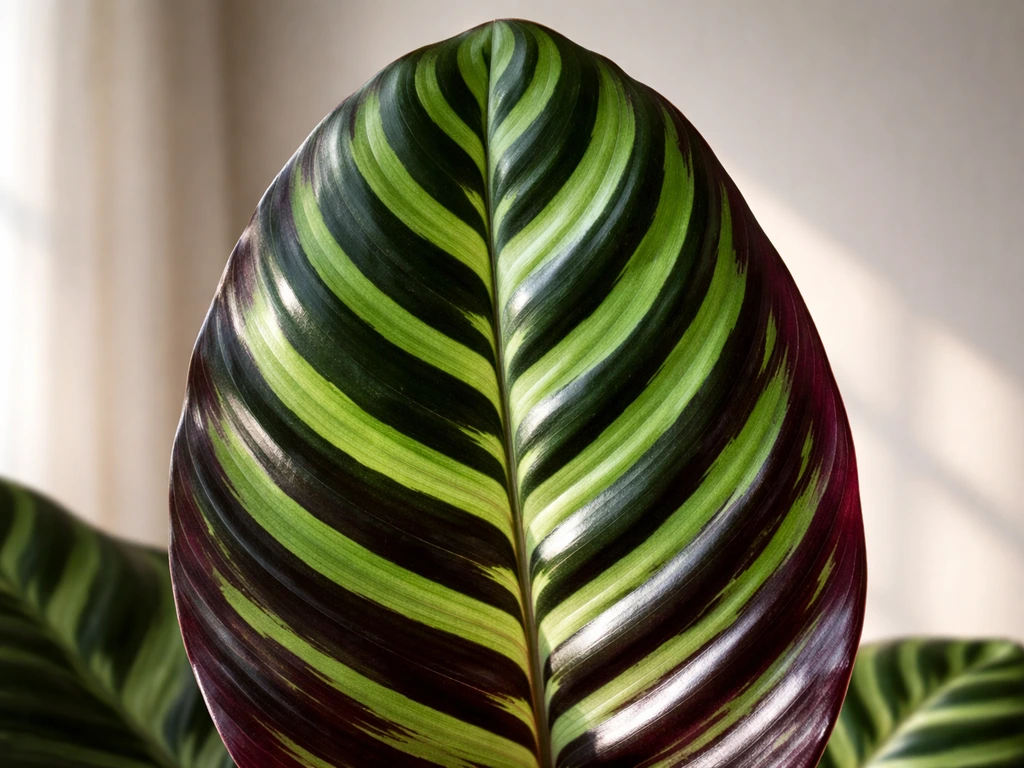
Every calathea care guide says "bright indirect light," and that phrase does a poor job of communicating anything useful. What it actually means: calatheas want enough light to power healthy photosynthesis and maintain their dramatic leaf patterning, but they cannot handle the heat or intensity of direct sunbeams hitting the leaf surface. In practical terms, Mississippi State University Extension puts Calathea makoyana (peacock plant) in the medium-light category, roughly 75 to 150 foot-candles.
That is significantly less than what a sun-loving plant like a succulent wants, but more than what a snake plant can survive on. If you are switching from calathea care to a snake plant setup, the grow light requirements for a snake plant are a bit different, mainly in how much direct exposure you can tolerate snake plant grow light requirements. Think of it as the Goldilocks zone for a rainforest floor dweller.
Light matters for calatheas in two specific ways. First, intensity drives photosynthesis, and too little of it causes the leaf colors to fade and new growth to stall. The NCSU Extension profile for Goeppertia orbifolia directly links fading leaf color to insufficient light, and anyone who has watched a striking calathea slowly turn dull green over a winter knows exactly what that looks like. Second, spectrum quality affects how efficiently the plant uses the light it gets. Full-spectrum light that covers the blue and red wavelengths plants actually absorb makes a measurable difference in leaf health over time.
Do calatheas like grow lights? The direct answer
Calatheas respond well to grow lights at low-to-moderate intensity. Can you use a grow light for a bonsai tree? The same idea of using the right intensity and spectrum applies, but bonsai need their own specific timing and height from the leaves. They do not need a powerful setup built for flowering vegetables.
What they need is consistent, gentle, full-spectrum light for a predictable number of hours each day. Corals also depend on consistent light that supports photosynthesis, so matching intensity and spectrum is key to healthy growth consistent, gentle, full-spectrum light. Because their natural habitat is the rainforest understory, they are already adapted to light that arrives filtered and steady rather than intense and variable.
A well-dialed-in grow light actually removes a lot of the guesswork you deal with near windows, where light changes by season, weather, and time of day. For related setups, you will also want to match the intensity and spectrum to the needs of chaetomorpha when deciding the best light to grow it best light to grow chaetomorpha.
The main thing to get right is avoiding overexposure. Too much direct light, whether from a grow light positioned too close or left on too long, can scorch calathea leaves just as easily as direct sun from a window. OurHouseplants notes that too much direct sun can cause calathea leaves to become almost translucent, and the same damage can happen with a grow light that is too intense or too close to the foliage.
LED vs fluorescent: which grow light type works best
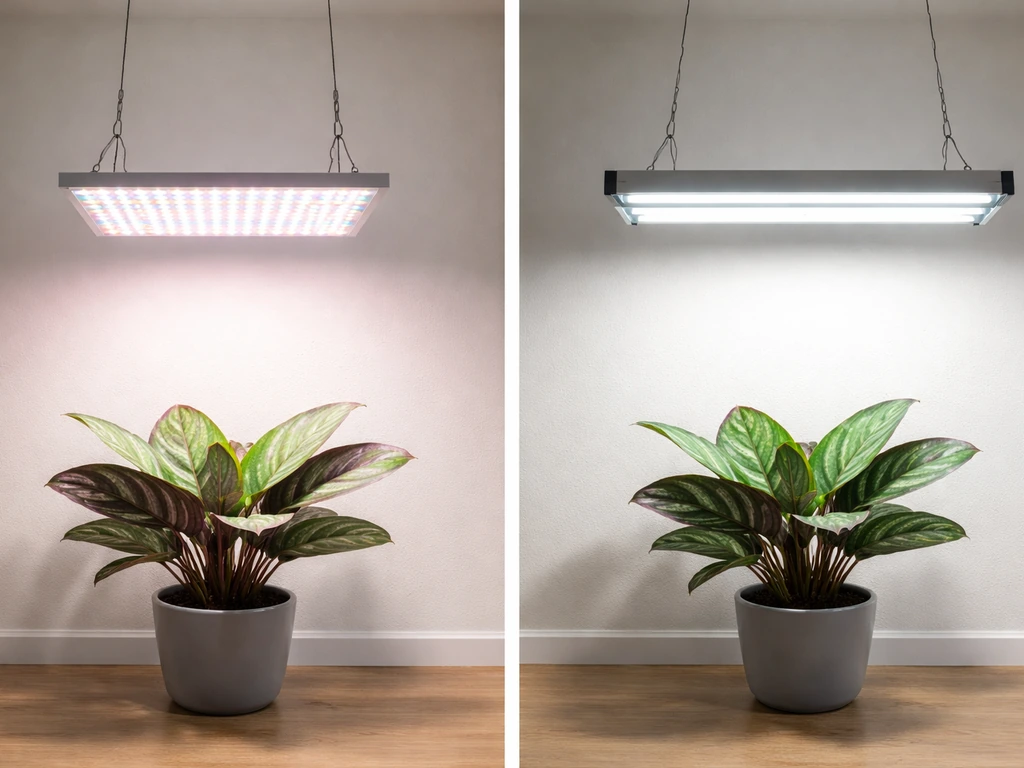
For calatheas, both LED panels and T5 fluorescent tubes get the job done, but they have real differences worth knowing about before you spend money.
| Feature | Full-Spectrum LED | T5 Fluorescent |
|---|---|---|
| Energy efficiency | High (runs cooler, lower electricity cost) | Moderate (more heat output) |
| Spectrum quality | Excellent (tunable or broad full-spectrum) | Good (6500K daylight bulbs cover growth spectrum) |
| Best for calatheas | Yes, especially at moderate intensity settings | Yes, well-suited for low-canopy foliage plants |
| Lifespan | Long (50,000+ hours typical) | Shorter (10,000–20,000 hours typical) |
| Heat output near leaves | Low | Moderate (keep distance in mind) |
| Upfront cost | Higher | Lower |
| Scalability | Easy to adjust output on dimmable models | Fixed output per bulb |
Full-spectrum LEDs are the better long-term investment for most indoor gardeners. They run cooler, last longer, and many models are dimmable, which is genuinely useful when you are dialing in the right intensity for a sensitive plant like a calathea. That said, T5 fluorescent tubes work well and are a completely reasonable choice, especially if you already have a fixture. Look for 6500K bulbs, which sit in the daylight range and support vegetative growth well. Skip the 2700K warm-white tubes, which are better suited for flowering plants.
Avoid cheap, low-wattage "blurple" LED panels that only emit red and blue light. They can work technically, but the light they produce is harsh and unpleasant to be around, and they skip parts of the spectrum that contribute to robust leaf development. A quality full-spectrum LED, even a modest one, is a better starting point.
How much light and how long to run it
For calatheas, aim for a PPFD (photosynthetic photon flux density, the actual measure of usable light hitting the leaf) in the range of 50 to 150 micromoles per square meter per second at the leaf level. That corresponds roughly to the 75 to 150 foot-candle medium-light category that extension sources use for this genus. If your light does not come with a PPFD reading, a basic light meter or even a free smartphone lux meter app can give you a workable estimate. One foot-candle equals about 10. Spectrum matters: converting lux to PPFD depends on the light spectrum, so spectrum-aware estimation is needed one foot-candle equals about 10. 76 lux, so 150 foot-candles is approximately 1,600 lux at the leaf.
Distance from the light to the plant matters a lot. As a starting point for a modest full-spectrum LED panel (equivalent to around 40 to 60 watts actual draw), 12 to 18 inches above the foliage is a reasonable starting distance. For T5 tubes, you can get a little closer, around 10 to 15 inches, because they are lower intensity. These are starting points, not rules carved in stone. Watch your plant and adjust from there. For a fiddle leaf fig, you’ll typically want the grow light higher and closer to the plant than you would for a calathea, aiming for brighter, more direct intensity where to place grow light for fiddle leaf fig.
Daily duration is where a lot of people either underdo it or overdo it. Calatheas grow naturally where day length is relatively consistent year-round (tropical latitudes), so giving them 12 to 14 hours of light per day is a solid target. Going above 16 hours is not necessary and starts to interfere with the plant's natural rest cycle. Under 10 hours, especially in winter, and you will likely see the same slow decline you get from a dark window spot.
Placement and setup that actually works
Windows vs grow lights
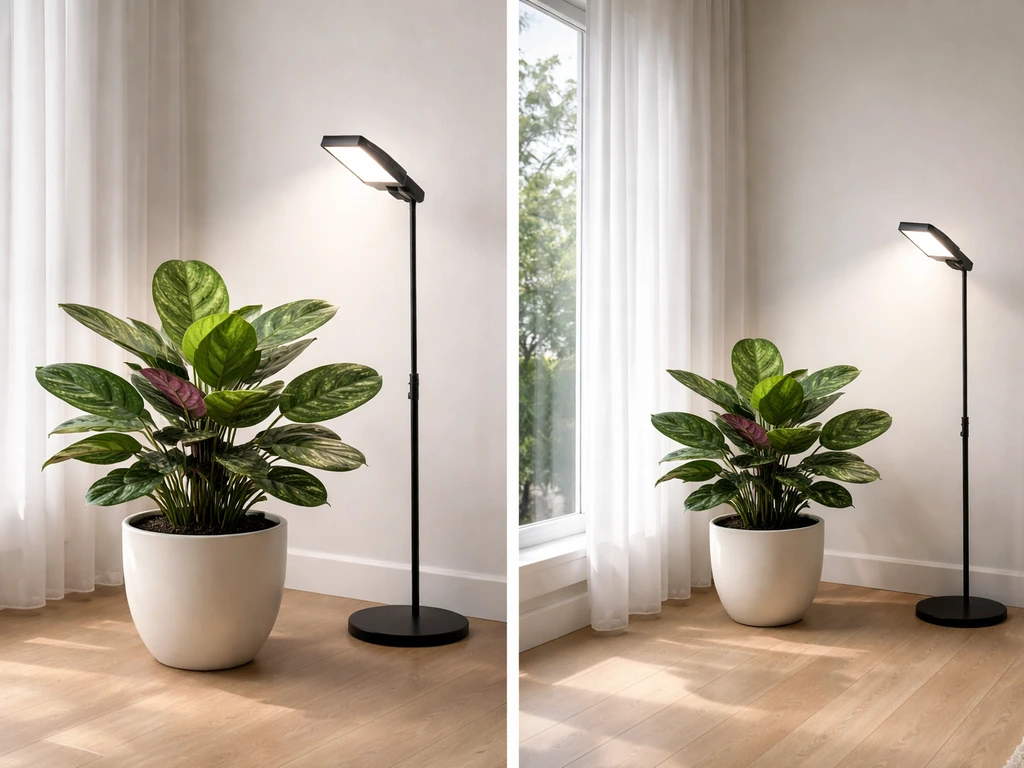
An east or north-facing window can work for calatheas if you have one with decent outdoor exposure, as Bloomscape suggests east, west, or north windows as options. But windows are inconsistent, and calatheas do not love inconsistency. Light drops significantly in winter, on cloudy days, and in rooms with obstructions outside. A grow light gives you the same intensity every day regardless of what is happening outside, which is one reason why I lean toward grow lights for these plants in most apartments and homes.
Setting up your light
- Start with the light 12 to 18 inches above the top leaves for LED, or 10 to 15 inches for T5 tubes.
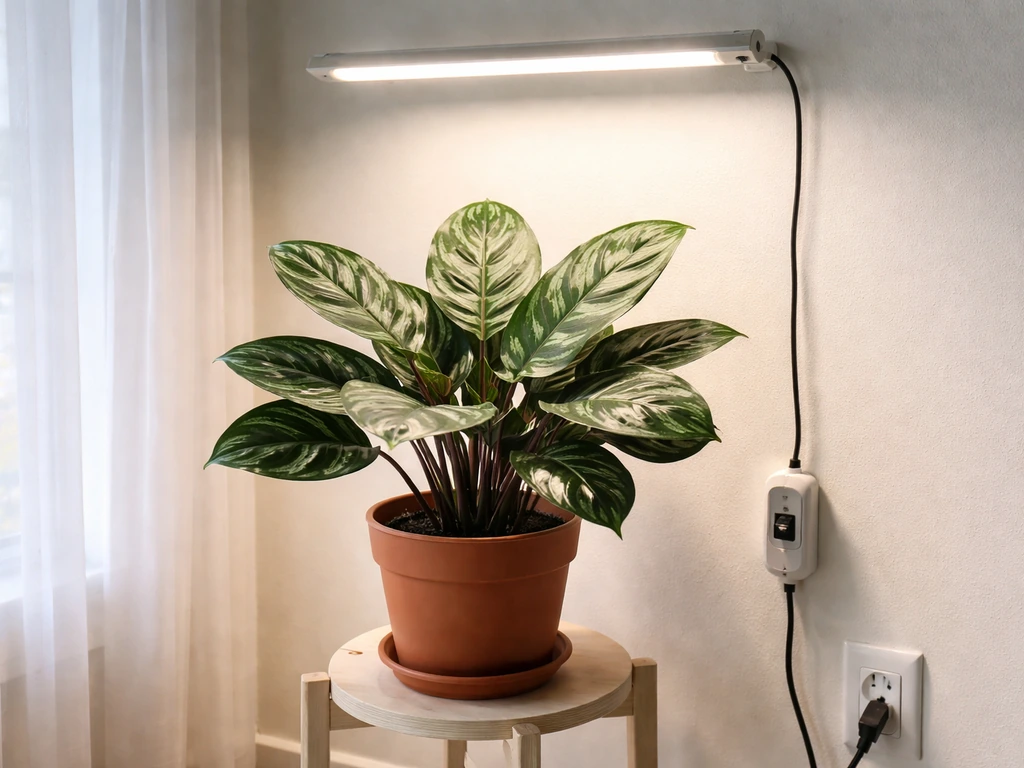
- Set a timer for 12 to 14 hours per day and keep it consistent. Plug-in outlet timers cost a few dollars and are one of the best investments you can make for any grow-light setup.
- Position the light so it covers the whole plant canopy, not just one side. If you are using a single bulb or small panel, make sure it is centered above the plant rather than off to one side, which causes uneven stretching.
- Avoid placing the grow light directly next to a heat source like a radiator or vent. Calatheas are already sensitive to dry, warm air, and adding a heat-generating light into that mix causes compounding stress.
- If you are supplementing a window with a grow light (rather than replacing the window entirely), position the light to fill in the hours when natural light is not available, or use it to boost a genuinely dim spot year-round.
How to tell if your calathea is getting too little or too much light
Calatheas communicate clearly through their leaves, and once you know what to look for, diagnosing a light problem is pretty straightforward.
Signs of too little light
- Leaf colors fade or wash out, particularly the bold greens, purples, and patterns the plant is known for
- New leaves come in smaller than expected or grow very slowly
- The plant stops producing new growth for extended periods outside of normal dormancy
- Stems become leggy as the plant reaches toward any available light source
- Overall appearance looks dull and flat compared to when you first got the plant
Signs of too much light or incorrect placement
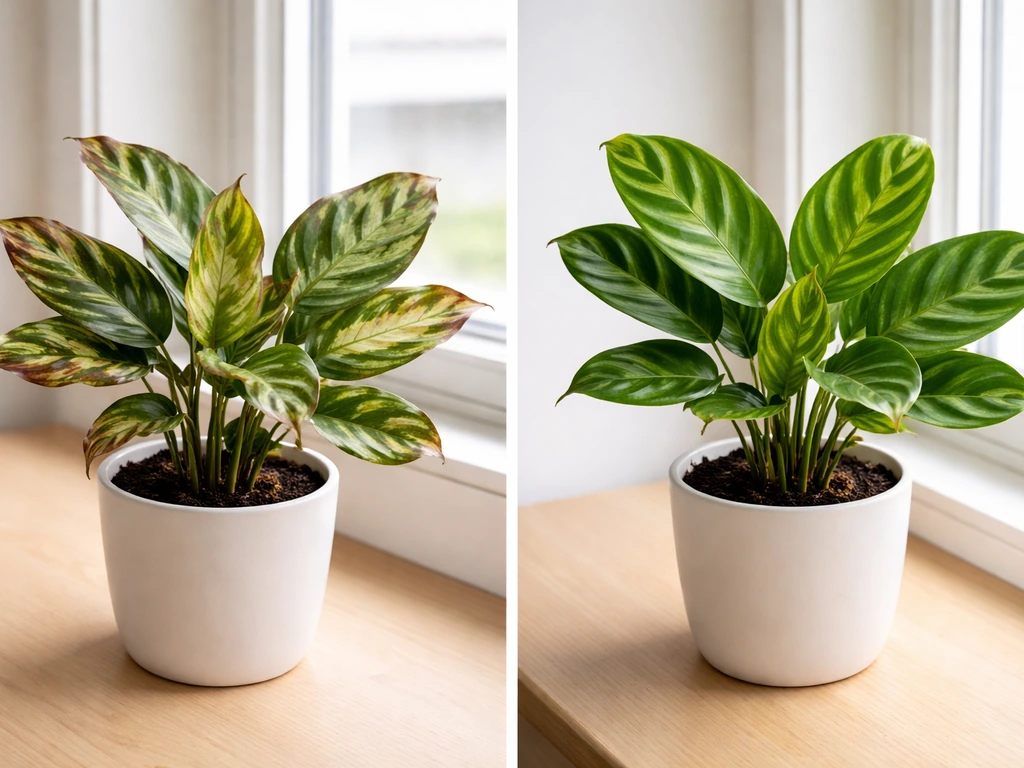
- Leaf edges turn brown or crispy, especially if combined with low humidity
- Leaves look bleached, washed out, or almost translucent in patches
- Leaves curl under or inward during the light period and do not fully unfurl
- Scorched patches appear on the upper leaf surface directly facing the light
- Colors fade toward yellow-white rather than deep green
Adjustment checklist
- If you see fading or slow growth, move the light 2 to 3 inches closer or increase daily duration by 1 to 2 hours. Wait two weeks before judging the result.
- If you see brown edges or bleached patches, move the light 3 to 4 inches farther away first. If that does not help within two weeks, reduce the daily on-time by an hour.
- If leaves are curling, check humidity and soil moisture before adjusting light, as curling is often a humidity or watering issue rather than a light issue.
- If one side of the plant is stretching toward the light, rotate the pot a quarter turn weekly and reposition the light to be centered above the canopy.
- If colors are fading and you already have adequate intensity, check that your bulb is full-spectrum. A warm-white or single-spectrum bulb will not replicate natural daylight quality.
Lighting works best when the rest of care is also right
Here is where a lot of people get stuck: they improve the lighting and still watch their calathea struggle, because lighting interacts with humidity, watering, and air conditions in ways that are easy to overlook. Calatheas are tropical plants that evolved in humid rainforest environments, and brown crispy leaf edges are one of the most common complaints. The thing is, crispy edges are usually a humidity and transpiration problem, not a light problem. When a plant loses moisture through its leaves faster than the roots can replace it, the edges dry out first. A grow light running 13 hours a day in a dry room can accelerate that process even at a perfectly appropriate intensity.
Keep humidity above 50 percent if you can, ideally closer to 60 percent, by grouping plants together, placing a tray of pebbles and water nearby, or using a small humidifier near your plant shelf. Water calatheas when the top inch of soil is dry, using room-temperature water, and never let them sit in waterlogged soil. These are not lighting issues, but they will completely undermine a good lighting setup if they are off. Wipe the leaves occasionally with a damp cloth too, since dust buildup on the leaves physically blocks light absorption and is an easy thing to fix.
Calatheas share a lot of care needs with other low-light foliage plants. If you are already growing philodendrons or snake plants under grow lights, your calathea will likely slot into the same setup without much adjustment, though calatheas are notably more sensitive to heat and dry air than either of those. The core lighting principles are similar across most tropical foliage houseplants: moderate intensity, full spectrum, consistent daily hours, and enough distance to avoid scorching.
Get those fundamentals right, and a calathea under grow lights can look as good, honestly sometimes better, than one near a bright window. If you are also wondering about fiddle leaf figs, their light needs are different, but you can still use grow lights successfully when you dial in the right intensity under grow lights. The consistency is the whole point.
FAQ
How do I tell if my grow light is too intense for my calathea?
Look for symptoms that appear quickly after you change the light (within days), such as leaf edges turning pale, almost translucent, or developing scorched patches. If the patterning looks bleached or washed out while the soil is still properly moist, increase the distance or lower the intensity rather than adding more hours.
Can I use a timer for calatheas, and what should the schedule be?
Yes, a timer helps because calatheas prefer steady day length. Use a consistent daily window of about 12 to 14 hours. If you notice slow recovery or dull growth after switching lights, shorten by 1 to 2 hours first, since overly long schedules can disrupt their rest cycle.
My calathea is still fading even though I increased light, what else could be wrong?
Check humidity and watering before assuming the light is insufficient. Crispy or drying edges usually indicate the plant is losing moisture faster than the roots can replace it, which can happen in dry rooms even when light intensity is correct. Also wipe dust off leaves, since dust reduces the effective light reaching the leaf.
Should I aim for PPFD or foot-candles, and what if my light only lists lux?
PPFD is the best target because it measures usable photons, but foot-candles and lux can work as an estimate. If your light only lists lux, use the article’s conversion (150 foot-candles is about 1,600 lux). If you can, measure at the leaf level after the light warms up and after you position the plant where it will actually live.
How high should I hang the light, and how do I adjust it without stressing the plant?
Start at about 12 to 18 inches above the foliage for a modest full-spectrum LED, then adjust gradually. When fine-tuning, change only one variable at a time, distance or intensity, and wait about a week to judge results, because calatheas often show slow changes rather than instant feedback.
Are blurple (red and blue only) grow lights ever a good idea for calatheas?
They are usually not ideal for calatheas because the missing spectrum can make light feel harsh and can limit how well the plant uses what it receives. If you already own one, reduce exposure time and keep distance generous to lower stress, but for best long-term leaf health, switch to a fuller-spectrum LED when you can.
Can I run grow lights at night instead of daytime?
For calatheas, the key is consistency, not the time of day. If your schedule makes nighttime lighting necessary, keep the duration the same (12 to 14 hours) and maintain a similar temperature and humidity. Avoid placing the light so close that the leaves heat up while lights are on.
Do I need to adjust the light setup in winter?
Often, yes, because rooms can become cooler and drier, and windows matter less if they are cloudy. Even with grow lights, you may need to monitor leaf dryness and adjust humidity. If growth slows and leaf color dulls, verify distance and daily duration rather than assuming the light output has changed.
What if my grow light is the right spectrum, but my calathea still has brown edges, could it be the light?
Brown crispy edges are more commonly humidity and transpiration related than a direct-light problem. Confirm that you are not letting the soil dry out too much, and keep humidity above 50 percent if possible (closer to 60 percent). If edges worsen right after lowering the light distance, then light intensity may also be contributing.
Can I place my calathea directly under a grow light or do I need it slightly to the side?
You can place it directly under the center of the light if the intensity at the leaf level stays within the target range. If the lamp has hot spots, rotating the pot weekly can prevent uneven exposure, especially if only part of the canopy is bleaching or paling.