
Yes, fiddle leaf figs do well under grow lights, and in many homes they actually thrive better with a dedicated grow light than they do parked near a dim window. They need bright indirect light to stay healthy, which is genuinely hard to deliver indoors without help. For a snake plant, the grow light requirements are different, and you can usually use a lower intensity than you would for a fiddle leaf fig snake plant grow light requirements. If your space doesn't have a south- or west-facing window with several hours of good light daily, a grow light isn't just a nice-to-have, it's the reason your plant survives winter without dropping half its leaves. Do jade plants like grow lights too, especially when indoor light is weak?
Do Fiddle Leaf Figs Like Grow Lights? How Much and How to Set Up
Marcus Hartley
11 Jun 2026
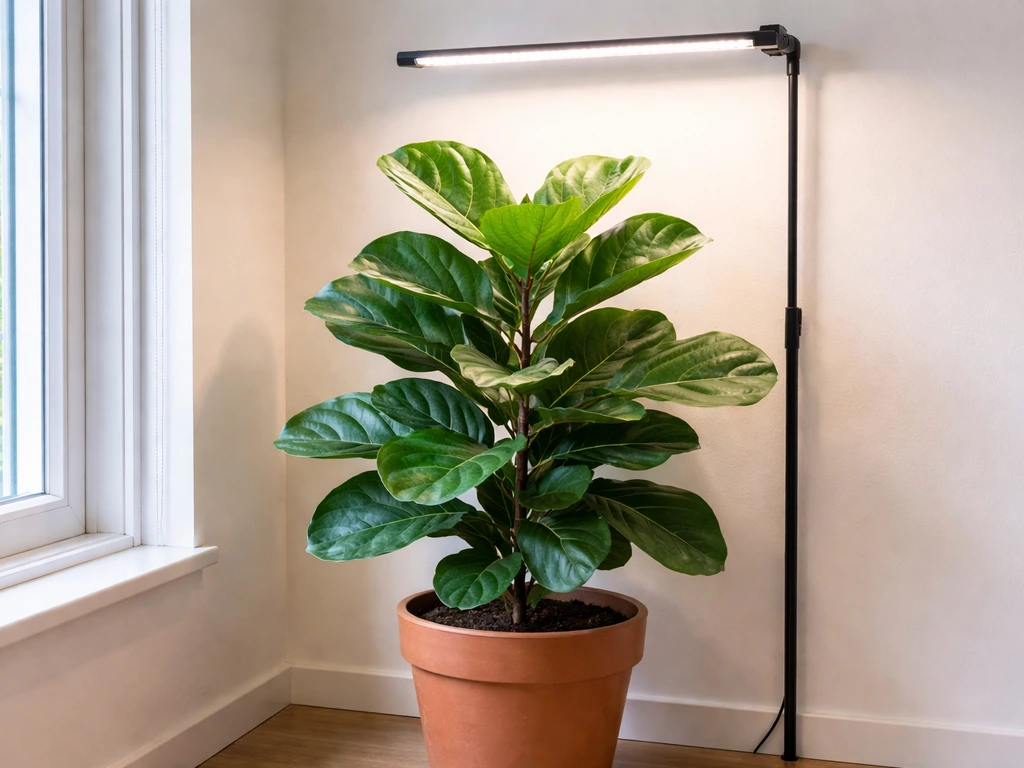
Grow lights vs. natural light: what fiddle leaf figs actually prefer
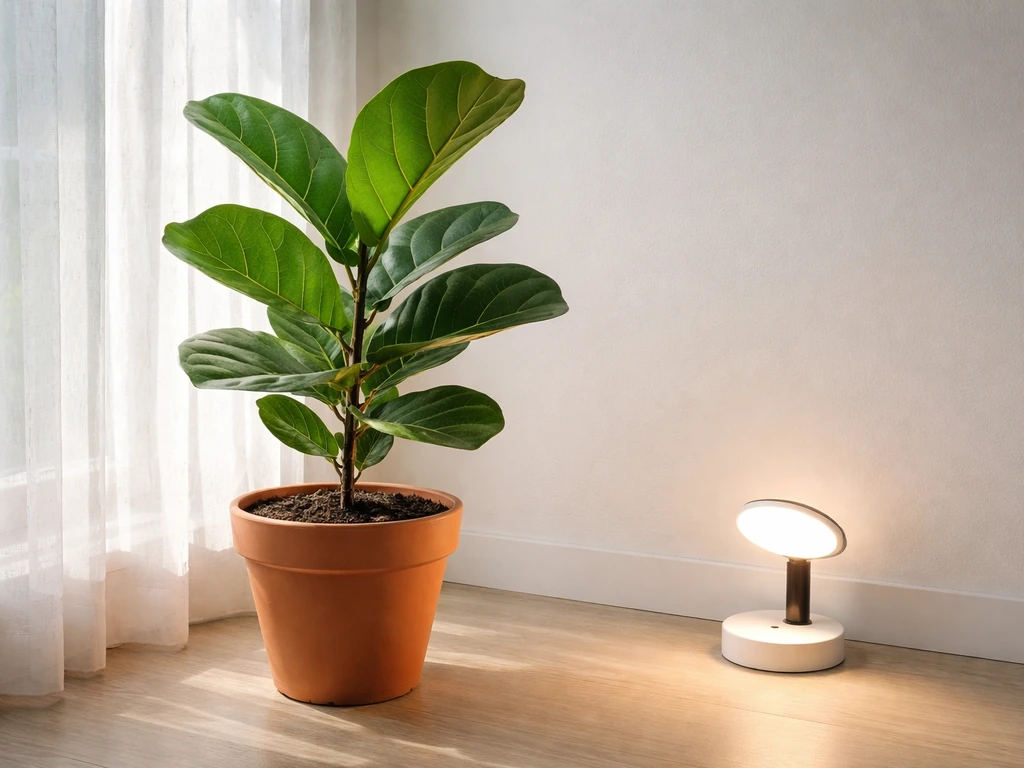
Fiddle leaf figs (Ficus lyrata) are not low-light plants. NC State Extension describes them as preferring bright indirect light or partial shade, and UF/IFAS lists their light requirement as partial shade with two to six hours of direct sunlight per day. That's a meaningful chunk of light, and most living rooms simply don't deliver it consistently, especially from fall through winter when the sun angle drops and days get short.
A grow light doesn't replace the sun's full spectrum or intensity, but it absolutely fills the gap. The honest framing is this: your fiddle leaf fig would love a bright conservatory with filtered southern light all day. Since most of us don't have that, a quality grow light gets the plant close enough that it stays vigorous, holds its leaves, and keeps pushing new growth. I've kept a fiddle leaf fig in a north-facing apartment room for two full winters using a single LED panel, and it did better than it ever did squeezed next to an east window.
How much light does a fiddle leaf fig actually need?
Under artificial light, aim for 12 to 14 hours per day. blank" rel="noopener noreferrer">K-State Extension specifically notes this range as adequate for houseplants receiving supplemental light, and it mirrors what the plant would get during a productive growing season. Don't try to go longer thinking more is better, plants need a dark period too, and running lights 16 or 18 hours creates stress over time.
For brightness, fiddle leaf figs want light in the range of 2,000 to 4,000 foot-candles (roughly 21,500 to 43,000 lux) at the leaf surface. Most grow lights list their output in lumens or PPFD (micromoles per square meter per second), so if you're comparing products, look for a PPFD of at least 200 to 400 µmol/m²/s at the canopy level. The exact number matters less than getting the placement right.
Distance: how close is close enough?
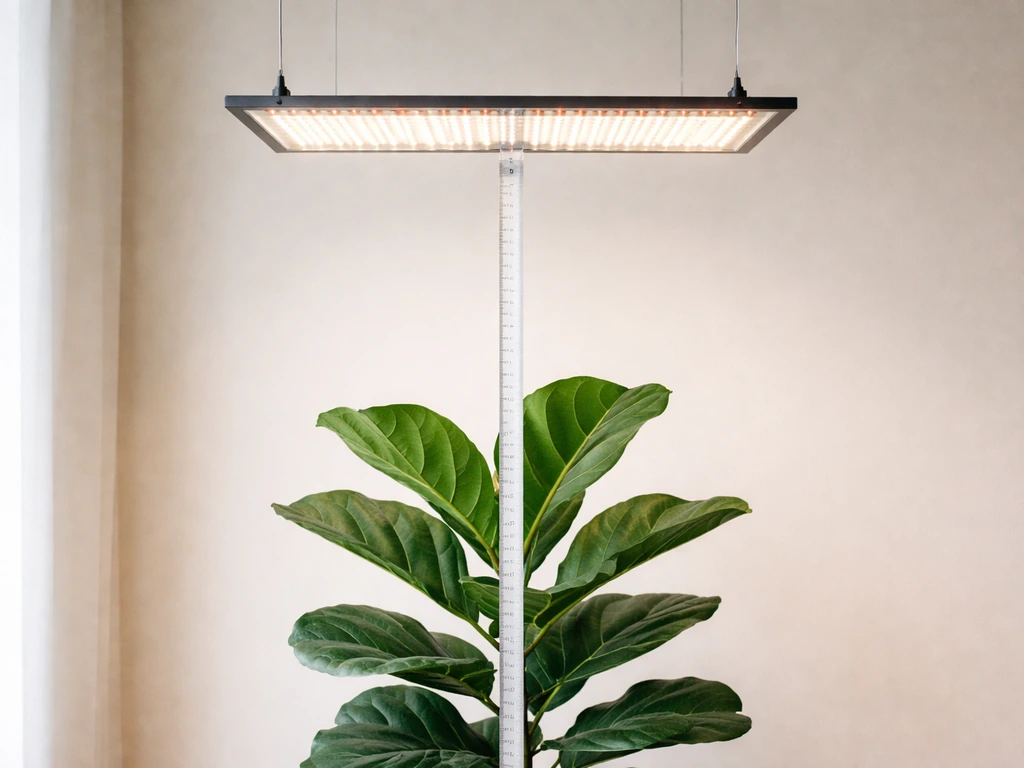
Distance is where most people go wrong. A high-quality LED panel placed 18 to 24 inches above the top of the plant is a solid starting point. Fluorescent tube fixtures typically need to be closer, around 6 to 12 inches, because they're lower intensity. Always check your specific light's manufacturer guidelines and then use a cheap lux meter (under $15 on most platforms) to confirm you're hitting the right intensity at leaf level. It takes the guesswork out completely.
The best grow lights for fiddle leaf figs
LED grow lights are the clear winner for fiddle leaf figs and most large houseplants. They run cooler, use less electricity, and modern full-spectrum LEDs cover both the red and blue wavelengths that drive photosynthesis and leaf development. Fluorescent options (T5 or T8 tubes) work fine for smaller plants or seedlings, but they're usually not practical for a mature fiddle leaf fig that can reach five or six feet tall indoors, you'd need multiple fixtures and constant repositioning.
| Light Type | Best For | Typical Distance | Heat Output | Running Cost |
|---|---|---|---|---|
| Full-spectrum LED panel | Mature fiddle leaf figs, ongoing use | 18–24 inches | Low | Low |
| LED grow bulb (standard base) | Smaller plants, supplemental fill light | 12–18 inches | Low–Medium | Low |
| T5 fluorescent tubes | Seedlings, small plants, shelving | 6–12 inches | Medium | Medium |
| HID / HPS lights | Not recommended for home use | Varies | High | High |
For spectrum, you want a full-spectrum or broad-spectrum light that includes both blue wavelengths (around 400–500 nm, which support compact leafy growth) and red wavelengths (around 600–700 nm, which drive photosynthesis efficiency). Most lights marketed as 'full spectrum' or 'daylight spectrum' cover this adequately. You don't need to obsess over specific nanometers, just avoid narrow-band purple grow lights, which are designed for flowering crops and look odd in a living room anyway.
Setting up your grow light without causing new problems
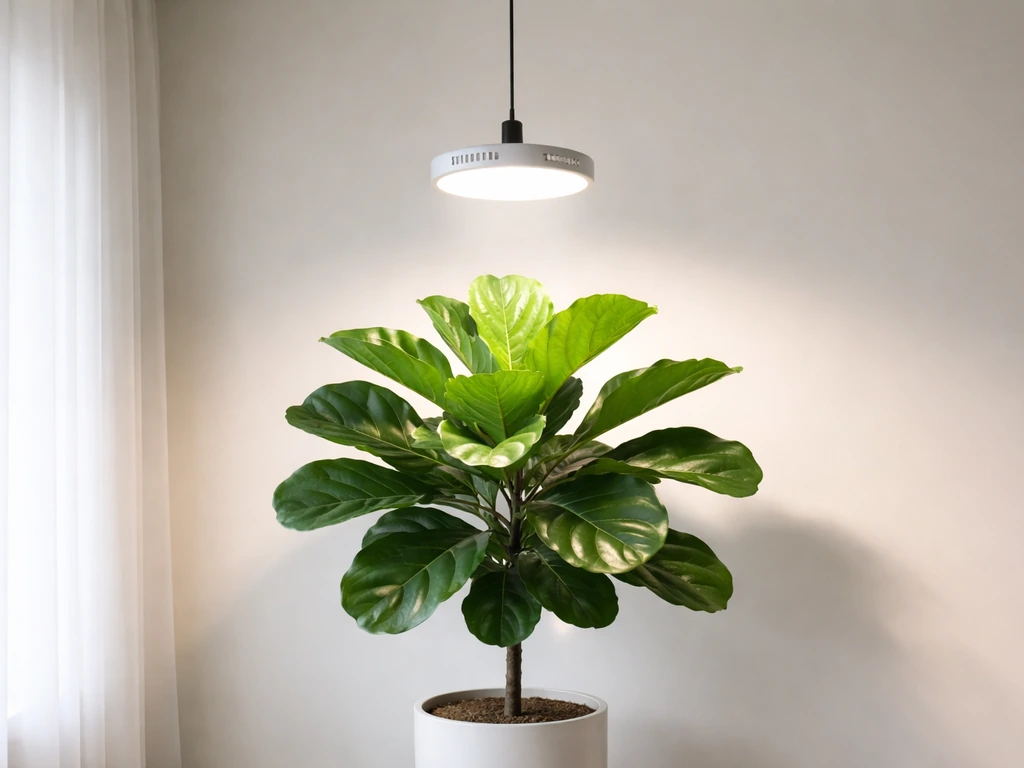
Placement and setup matter as much as which light you buy. A great light hung wrong will still give you uneven growth or stressed leaves. Here's how to set it up properly from the start.
- Position the light directly above the plant, centered over the canopy. Angling it to the side creates uneven light distribution and the plant will lean toward the strongest source.
- Start at 24 inches above the top leaves and adjust from there. Move it closer if growth is slow or stems are stretching; move it farther if you see bleaching or crispy patches.
- Use a timer set to 12–14 hours on and 10–12 hours off. Consistency matters — fiddle leaf figs respond well to a predictable light cycle. I use a simple mechanical outlet timer that costs about $10.
- Rotate the plant a quarter turn every 1–2 weeks. Even a centered light can't perfectly reach all sides of a large, bushy plant. Rotating prevents one side from lagging behind in growth.
- Keep the light at least 18 inches from the nearest wall if possible. Reflective walls can create hot spots on leaves closest to them.
- Check the temperature near the plant canopy. LED lights are generally safe, but if you're using older fluorescents or a high-output LED close-up, make sure the ambient temperature around the leaves stays below 85°F (29°C).
How to tell if the light is working (or isn't)
Your fiddle leaf fig will tell you pretty clearly when something's off. The trick is knowing which symptom points to light versus other issues like watering or root problems.
Signs your plant needs more light
- Leggy, elongated stems with wide gaps between leaves — the plant is stretching toward the light source
- Lower leaves dropping off for no obvious watering or root reason — inadequate light reaching the lower canopy is a classic trigger
- New leaves coming in noticeably smaller than older ones
- Pale, washed-out leaf color or slow growth through the spring and summer when the plant should be active
- The plant leaning hard in one direction even after you've rotated it
Signs your plant is getting too much light
- Pale tan or light brown patches, typically on the side or top leaves facing the strongest light source — this is sunscorch and can happen quickly after you move a light closer
- Leaves that look bleached or faded rather than a rich, deep green
- Crispy brown leaf edges combined with soil drying out very quickly
- Drooping leaves even when the soil is adequately moist
If you see scorch patches, move the light up by 4 to 6 inches and give the plant a week to stabilize before making another adjustment. If you're seeing stretching and leaf drop, bring the light 4 to 6 inches closer and confirm your timer is running the full 12 to 14 hour cycle. NYBG notes that leggy or unstable growth in Ficus lyrata usually signals inadequate light, and lower leaves that do not receive enough light may drop off stretching and leaf drop.
Common mistakes and how to fix them today
Most grow light problems with fiddle leaf figs come down to a handful of very fixable errors. Here are the ones I see and hear about most often.
| Mistake | What You'll See | Quick Fix |
|---|---|---|
| Light is too far away | Leggy stems, pale leaves, lower leaf drop | Move light 4–6 inches closer; confirm PPFD at canopy level |
| Light is too close | Brown scorch patches, bleached leaves, fast soil drying | Raise the light 4–6 inches and monitor for a week |
| No timer or inconsistent hours | Erratic growth, general poor performance | Set a timer for 12–14 hours on, same time every day |
| Not rotating the plant | One side dense, other side sparse and leggy | Quarter-turn rotation every 1–2 weeks |
| Light positioned off to the side | Plant leaning, uneven canopy | Reposition light directly above the center of the plant |
| Overheating near the canopy | Leaf curl, rapid wilting, brown tips | Check temperature at canopy; switch to LED if using older bulbs |
One mistake that catches people off guard is expecting instant results after setting up a grow light. Fiddle leaf figs are notoriously slow to show a positive response, give it four to six weeks before deciding the setup isn't working. New leaf growth is your best signal that conditions have improved. If you're not seeing any new leaves after six weeks and watering is on point, then it's worth reassessing the light distance and daily hours.
If you're also growing other houseplants alongside your fiddle leaf fig, it's worth knowing that species like philodendrons and calatheas have quite different light tolerances, philodendrons are more flexible, while calatheas prefer lower intensity. Philodendrons can also do well under grow lights, as long as you avoid blasting them with too much intensity. A single grow light that works perfectly for your fiddle leaf fig may be too intense for a calathea sitting nearby, so grouping by light needs makes setup much easier. If you mean a specific bonsai setup, the same basics apply: match the light intensity and duration to the species and keep an eye on leaf color and growth grow light.
The bottom line: fiddle leaf figs genuinely benefit from grow lights, and with a full-spectrum LED, a reliable timer, and a bit of attention to placement, you can keep one thriving even in a space with almost no usable window light. For chaetomorpha, the best light to grow it comes down to giving it enough intensity and a consistent photoperiod so it can rapidly photosynthesize best light to grow chaetomorpha. It's not complicated once you know what the plant is telling you. Corals have their own light needs too, usually requiring strong illumination for photosynthesis from symbiotic algae.
FAQ
How do I know my fiddle leaf fig is getting enough light from a grow light?
Look for slow, steady signs of “happy” growth: new leaves that are expanding normally, less leaf drop, and consistent leaf color. A practical check is to measure at the leaf surface after you mount the light, since the same fixture can underperform if it sits farther than intended.
Can I use a grow light 24 hours a day for faster growth?
No, don’t run it continuously. Fiddle leaf figs need a dark period, and leaving lights on too long can lead to stress, weaker growth, or more problems that resemble watering issues. Stick to the daily photoperiod your setup is targeting, then use a timer.
Should I dim the grow light or move it closer if growth is slow?
Start with placement before changing intensity. Move the light in small steps (about 4 to 6 inches), then wait about a week to judge response. If you change brightness and distance at the same time, it becomes hard to tell what caused the improvement or setback.
Do I need to rotate the plant under a grow light?
Yes, rotation helps when the fixture is not perfectly centered over the canopy. Every 1 to 2 weeks, rotate the pot a quarter turn so growth stays even and you avoid leaning toward the light.
What height should I mount the light if my fiddle leaf fig keeps getting taller?
Re-check distance as the plant grows. Many people set it up once and forget it, but intensity drops quickly with height. Use a simple rule: keep the leaf surface at the target range and adjust every time you see new growth extending above the previously lit area.
Will a grow light dry out the soil faster than a window does?
It can, because increased light and airflow can raise evaporation. If you notice the top inch drying sooner, don’t automatically increase watering; instead, confirm with a moisture check (finger or moisture meter) and adjust frequency rather than quantity.
Is it safe to leave a grow light on during travel or holidays?
Only if you have reliable timing. Use a plug-in timer you can test before you go, and avoid “smart home” schedules that might change with Wi-Fi issues. If you will be gone long enough to extend beyond your normal light hours, consider temporarily shortening the daily schedule rather than letting it run longer.
Can I place a fiddle leaf fig directly under the LED panel or should it be offset?
Either can work, but direct positioning often creates uneven “hot spots.” If you see scorch patches on only parts of the leaves, offset slightly and raise the fixture, then re-measure at the canopy level.
What’s the difference between PPFD and lux, and what should I rely on?
PPFD is more useful for plant photosynthesis planning, but lux is easier to measure for many shoppers. The best approach is what your article already hints at: aim for the intensity range at the leaf surface, and use a lux meter or the fixture’s PPFD spec if you have it.
Will a grow light help if my fiddle leaf fig is already dropping leaves?
It can help, but first confirm it is a light problem. Sudden leaf drop often comes from watering stress, cold drafts, or root issues. If the potting mix stays wet for too long or the plant is sitting in a cold spot, adjust those first, then use the grow light to correct the light deficit.