The hypothesis that plants grow best in white light is mostly true, with one important caveat: what matters isn't that the light looks white to you, but that it delivers the right mix of wavelengths (especially blue and red), at the right intensity, for enough hours each day. A good full-spectrum white LED or fluorescent bulb checks all those boxes for most indoor plants, which is exactly why "use white light" has become reliable shorthand for grow light shopping. But "white" alone doesn't guarantee results. You still need to get the intensity and timing right, and some plants have specific needs that a generic white bulb won't perfectly match. If you’re wondering can colored lights affect how plants grow, it comes down to which wavelengths they provide and how balanced that spectrum is.
Plants Grow Best in White Light: A Practical Test and Rules
What the 'white light' hypothesis actually means
When people say plants grow best in white light, they're usually reacting against single-color grow lights (like old-school red-only or blue-only LEDs) or poor-quality bulbs that only cover a narrow slice of the spectrum. The idea is that white light, because it looks white to human eyes, must contain a broad range of wavelengths that plants can use. That logic is generally sound. A quality full-spectrum white LED or a good fluorescent bulb produces photons across the visible spectrum, including the blue wavelengths (roughly 400–500 nm) and red wavelengths (620–700 nm) that drive the bulk of photosynthesis and plant development.
Where the hypothesis falls short is when "white" becomes a marketing label rather than a meaningful description. Some cheap bulbs labeled "white" or "daylight" produce a narrow, spiky spectrum that looks white to your eye (human vision is easily fooled) but is actually quite unbalanced from a plant's perspective. So the hypothesis is true when the white light is genuinely broad-spectrum, and it needs a closer look when the label just means the bulb glows without a strong color cast.
How plants actually use light: spectrum vs. brightness
Plants don't care how bright light looks to you. If you want taller, faster growth, the key is getting enough photosynthetically useful light at the leaf, not just making the light brighter to your eyes will a plant grow higher with more light. They care about photons in the 400–700 nm range, what researchers call photosynthetically active radiation (PAR). Historically, researchers also demonstrated that plants require light for normal growth, not just for illumination plants need light to grow. The useful intensity metric here is PPFD, which stands for photosynthetic photon flux density and is measured in micromoles of photons per square meter per second (μmol·m⁻²·s⁻¹). If your science fair results seem inconsistent, double-check the PPFD at canopy height for each light setup. Lux and lumens, the units on most consumer bulb packaging, measure how bright a light appears to human eyes, not how much usable energy it delivers to a leaf. A warm-white incandescent lamp can look very bright in lux while delivering far fewer photosynthetically useful photons than a cooler LED of lower apparent brightness.
Beyond single-moment intensity, the total light a plant receives in a day is captured by a metric called DLI (daily light integral), which is simply PPFD accumulated over the photoperiod. Two setups with very different intensities can deliver similar DLI if one runs longer, and DLI correlates with growth outcomes better than any snapshot reading. Leafy greens and herbs typically want a DLI around 12 mol·m⁻²·day⁻¹ or higher, while foliage houseplants often get by on a DLI of roughly 6–10 mol·m⁻²·day⁻¹. Fruiting crops like tomatoes or peppers need considerably more.
Spectrum (color) operates alongside intensity but does something different: it shapes plant form and behavior through photoreceptors. Phytochromes respond to red and far-red light and influence shade avoidance, germination, and flowering transitions. Cryptochromes and phototropins respond to blue and UV-A and help regulate stem elongation, stomatal opening, and directional growth. This is why blue-enriched light tends to keep plants more compact (blue suppresses the stem stretching that makes etiolated seedlings leggy), while red-heavy light pushes biomass accumulation and flowering. A white light that includes both is doing a lot of good work simultaneously. Changing the color mix changes qualitative outcomes like shape and flowering timing, while changing the intensity changes raw growth rate and leaf mass. If you're wondering why plants can still stretch under dimmer conditions, that comes down to how light intensity and spectrum trigger elongation and shade-avoidance responses why do plants grow taller with less light.
Testing the hypothesis at home
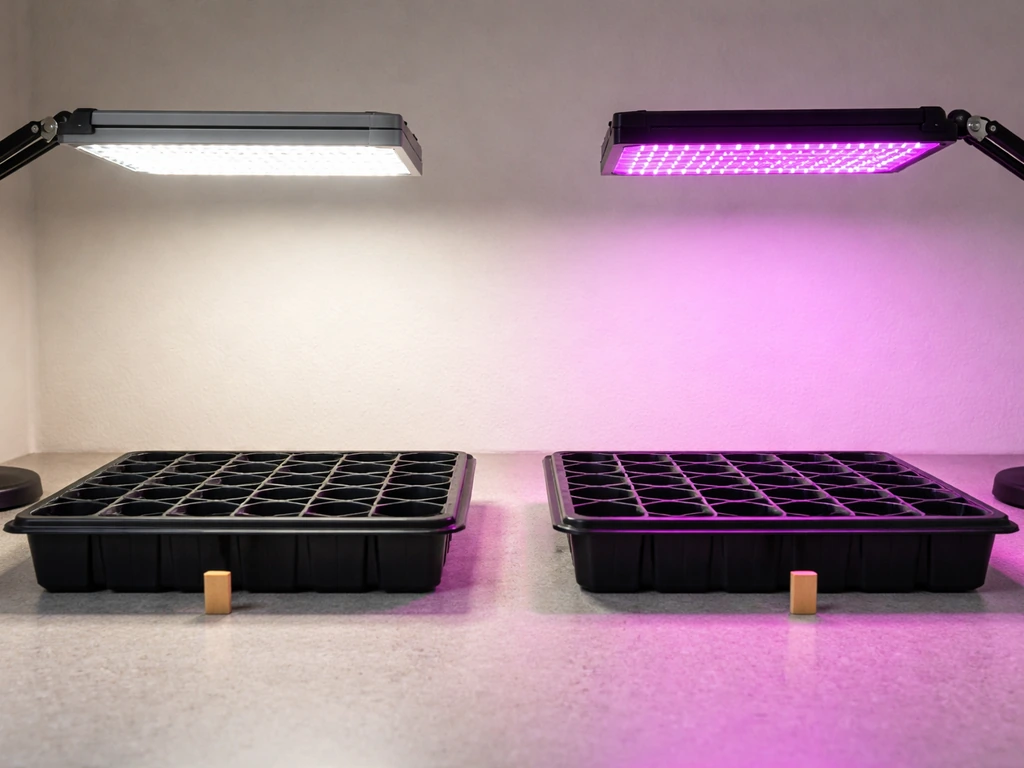
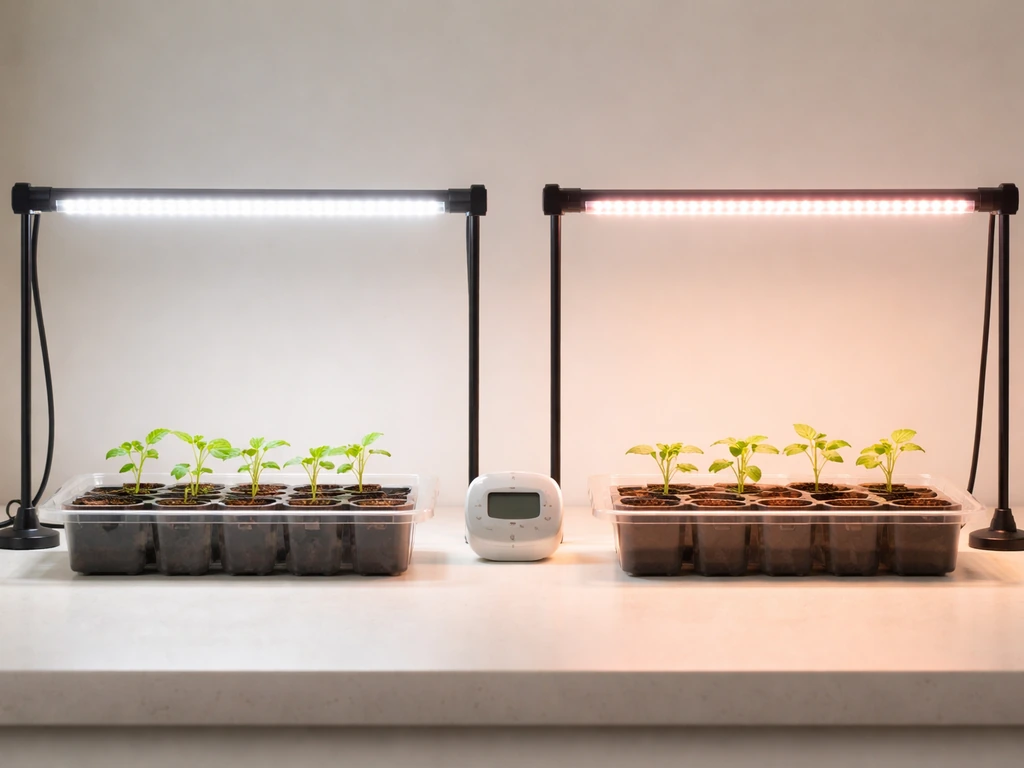
You don't need a lab to run a useful comparison. A simple split-trial with two identical seedling trays, one under a full-spectrum white LED and one under whatever you're comparing (a yellow incandescent, a red/blue "blurple" LED, or a single-color bulb), will give you observable data within two to four weeks. The key is controlling everything except the light: same soil mix, same watering schedule, same temperature, same distance from the bulb to the canopy, and the same photoperiod for both groups.
What to measure and observe
- Stem height every 3–4 days: leggy, stretched stems signal too little total light or too much far-red relative to blue
- Leaf color: pale or yellowing leaves often mean insufficient PAR; dark green/purpling can indicate stress or spectrum imbalance
- Leaf size and shape: smaller than expected leaves may indicate low DLI, while cupping or curling can flag heat or intensity stress
- Time to first true leaves (seedlings): faster emergence under better-spectrum light is one of the clearest early signals
- Flowering onset (if applicable): photoperiod and red/far-red ratio affect this, so even matched PPFD setups can diverge here
If you want a number rather than just visual observations, a PAR meter (or a PAR sensor attachment for your phone) lets you measure PPFD at canopy height under each setup. Even a $30–50 smartphone sensor won't be lab-grade, but it's plenty accurate for comparing two fixtures in the same space. Aim for consistent readings across the whole growing area, not just the hot spot directly under the center of the bulb. Uniformity matters: a ±15% variation in PPFD across the canopy is a reasonable target for most setups.
Choosing a grow light that delivers real 'white' spectrum
Shopping for grow lights is genuinely confusing because packaging mixes human-centric specs with plant-relevant ones, and "full spectrum" is used by marketers to describe everything from truly broad-spectrum LEDs to pink-purple blurple lights with a white mode. Here's how to cut through it.
Specs that actually matter for plants
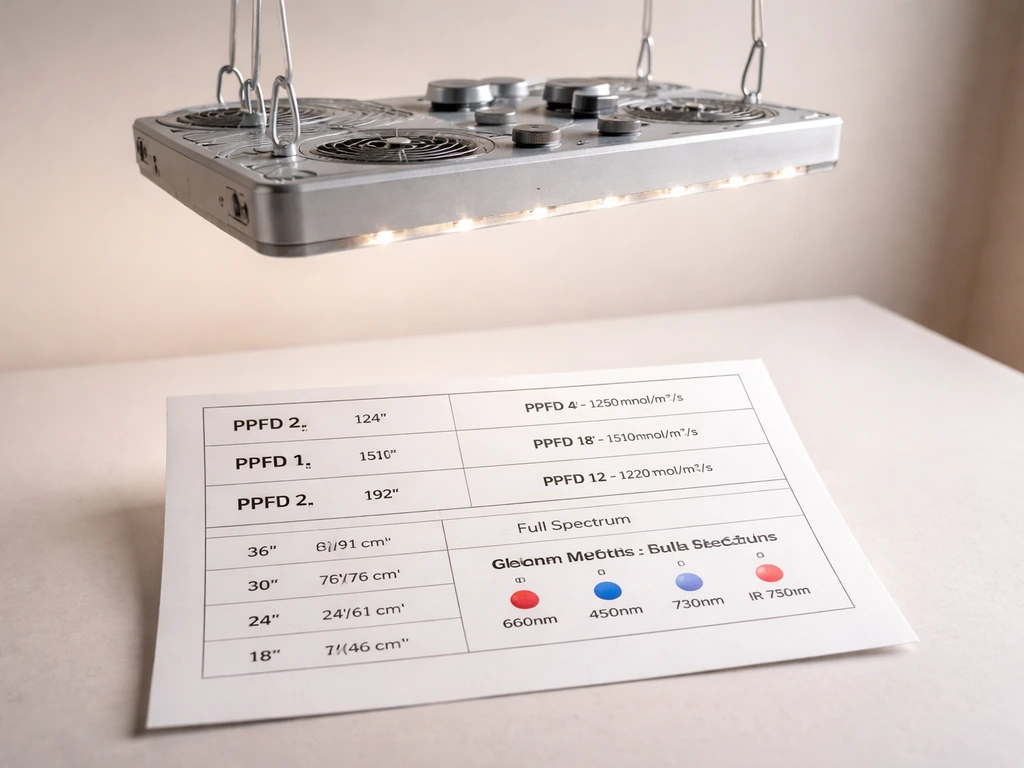
- PPFD rating at your intended hanging distance: look for this number in the fixture's spec sheet, not just wattage. A PPFD of 100–300 μmol·m⁻²·s⁻¹ at canopy is a workable range for leafy greens and most herbs
- Spectrum chart or SPD (spectral power distribution): a reputable brand will show you a graph of output across wavelengths. You want meaningful peaks in blue (400–500 nm) and red (620–700 nm) with reasonable coverage in between, not just two narrow spikes
- Color temperature (CCT): a range of 3000K–6500K generally indicates a broad white-appearing spectrum. Anything outside that range can still work but warrants a look at the SPD chart
- CRI (Color Rendering Index): a CRI above 80–90 suggests broader spectral coverage, but CRI is a human-vision metric, not a plant metric. Don't use it as your only filter, but it's a useful secondary signal
- DLI calculator or coverage area at target PPFD: good manufacturers provide this; it tells you whether the fixture actually covers your growing space at useful intensity
For most indoor gardeners growing herbs, leafy greens, or houseplants, a quality full-spectrum LED panel in the 2000K–6500K range from a brand that publishes an SPD chart will outperform a fancy-labeled bulb with no data behind it. Fluorescent T5 and T8 fixtures are still a solid, budget-friendly option, especially for seed starting and low-light foliage plants. They naturally produce a broad white spectrum and have decades of track record in horticulture.
| Light Type | Typical Spectrum Coverage | PPFD Potential | Best For | Watch Out For |
|---|---|---|---|---|
| Full-spectrum white LED panel | Broad, 380–780 nm (check SPD) | High, 100–1000+ μmol·m⁻²·s⁻¹ | Herbs, greens, fruiting crops, seedlings | Cheap versions with misleading "full spectrum" labels and no SPD data |
| T5/T8 Fluorescent (4000K–6500K) | Broad white, decent blue/red | Moderate, 50–200 μmol·m⁻²·s⁻¹ | Seedlings, leafy greens, low-light houseplants | Intensity drops fast with distance; replace bulbs annually |
| Blurple LED (red/blue only) | Narrow peaks, mostly 440 nm + 660 nm | Can be high | Certain single-crop setups where tuned ratios are desired | Harsh on eyes, poor for human monitoring of plant health |
| Warm white incandescent/halogen | Broad but red/IR heavy, minimal blue | Low for plants | Decorative supplementation only | Heat output, energy inefficiency, poor PAR/watt ratio |
| Standard household LED bulb | Varies widely; often green-heavy | Low to moderate | Low-light foliage close to the bulb | Not designed for plants; check SPD before relying on it |
Placement, distance, and photoperiod: the setup details that make or break results
A great grow light at the wrong distance is nearly useless. PPFD drops off quickly as you move a fixture further from the canopy, so the difference between 6 inches and 18 inches can mean the difference between 400 μmol·m⁻²·s⁻¹ and 80 μmol·m⁻²·s⁻¹ at the leaf surface. Start with the manufacturer's recommended distance, then adjust based on what you observe. Seedlings and high-light crops want the fixture closer; low-light foliage plants can tolerate more distance.
Distance guidelines by plant type
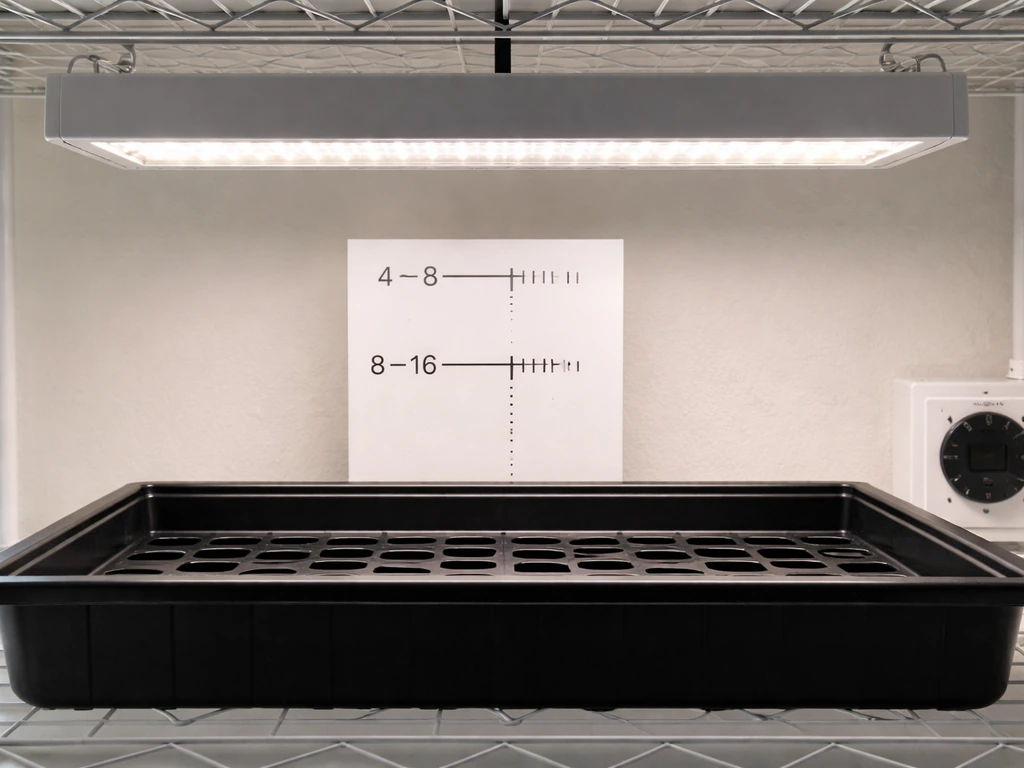
- Seedlings and microgreens: 4–8 inches from a moderate LED or T5, aiming for 150–250 μmol·m⁻²·s⁻¹
- Leafy greens and herbs: 8–16 inches from a quality LED panel, targeting 100–300 μmol·m⁻²·s⁻¹
- Fruiting crops (tomatoes, peppers, cucumbers): 12–24 inches from a high-output LED, targeting 400–600+ μmol·m⁻²·s⁻¹
- Low-light foliage houseplants (pothos, snake plants, peace lilies): 18–36 inches from a moderate fixture or direct ambient window light is often sufficient
For photoperiod, most experts and extension recommendations converge on 12–16 hours of light per day for indoor grows under artificial light. Virginia Tech Extension summarizes that many indoor and greenhouse lighting programs use about 12, 16 hours of light per day to support plant growth 12–16 hours of light per day). A timer is non-negotiable here: inconsistent photoperiods stress plants and can trigger premature flowering in day-length-sensitive species. I run most of my herb and vegetable setups on 14–16 hours, and foliage plants on 12–14. The dark period matters too since plants do important repair and development work overnight, so don't be tempted to run lights 24/7 hoping for faster growth. You'll often get the opposite.
Uniformity across the growing area is something most home growers overlook. If your fixture covers a 2×2 foot footprint but you're measuring PPFD only at the center, the edges might be getting 40–50% less light. Either use a smaller grow area than the fixture's rated coverage, or spread plants so the slower-growing ones sit at the center and rotate them periodically.
When things go wrong: recognizing and fixing common light problems
Most indoor plant problems trace back to light, and the signs are readable once you know what to look for. Here's a practical breakdown of what you're likely to see and what it means.
Not enough light (low PPFD or DLI)
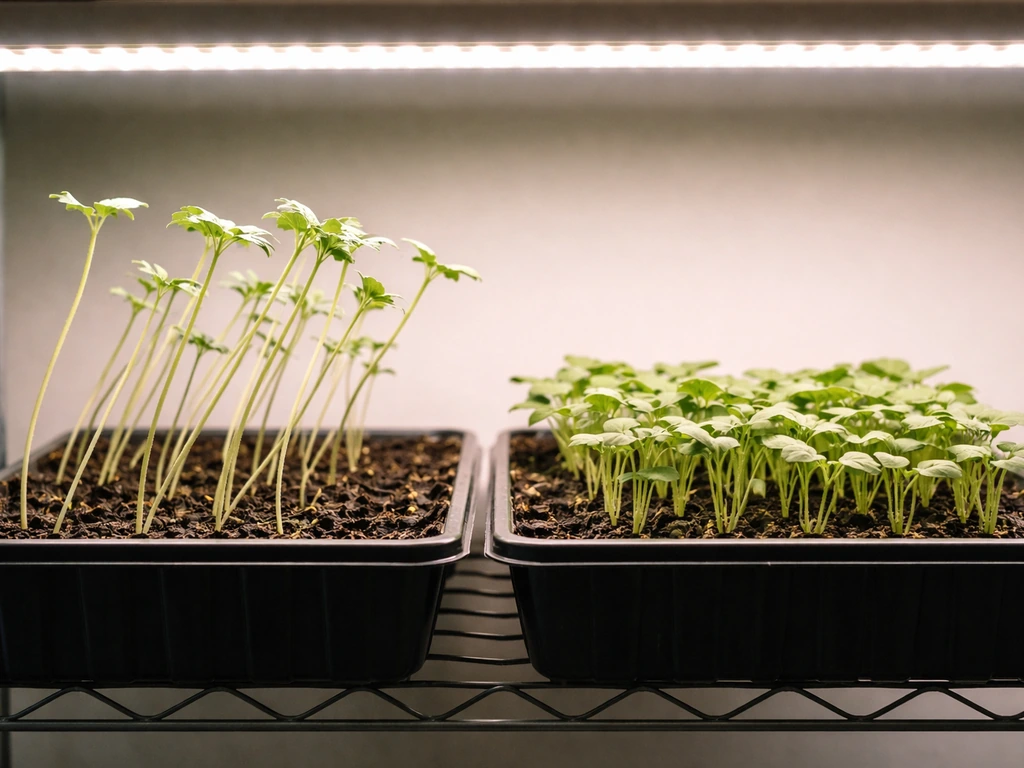
- Long, thin, pale stems reaching toward the light source (etiolation): the classic sign that a plant is not getting enough PAR
- Leaves spaced far apart on the stem instead of compact growth
- Slow or no new growth over several weeks
- Yellowing of lower leaves that don't recover with feeding
Fix: move the light closer, add a second fixture, or increase the photoperiod to bump up DLI. Check whether your bulb is actually delivering PAR at the canopy with a quick PPFD measurement if you can.
Wrong spectrum (imbalanced wavelengths)
- Very tall, soft stems even under bright light: often a sign of red-heavy or far-red-heavy spectrum without enough blue to suppress elongation
- Plants flowering at unexpected times or failing to flower: photoperiod and red/far-red ratio both influence flowering; a spectrum heavy in far-red can mimic shade signals
- Extremely dark, dense foliage without much growth: sometimes a blue-heavy spectrum without adequate red for photosynthesis
- Bleached or white patches on leaves (photoinhibition): intense light, especially blue, at close distances can cause this
Fix: switch to a broad-spectrum fixture with a published SPD chart showing balanced blue and red peaks. Spectrum complaints are often solved by upgrading from a budget no-data bulb to a quality full-spectrum LED.
Heat, drying, and algae
- Crispy leaf edges or curling: often heat stress from an LED or fluorescent positioned too close, especially over small seedling trays
- Soil drying out unusually fast under the light: normal for high-intensity setups, but water more frequently rather than raising the fixture if your PPFD is in the right range
- Green algae growing on the soil surface or on container walls: a sign that light is reaching moist soil directly; use a thin mulch layer or reduce soil surface exposure
Matching plants to your light setup (and avoiding the common mistakes)
Not every plant needs a powerful grow light, and part of getting good results is choosing plants that match what your setup can actually deliver. If you have a single medium-output T5 fixture in a small apartment, that's perfect for herbs like basil, cilantro, and parsley, leafy greens like lettuce and spinach, and most low-light foliage houseplants. But even if you have only green light, you can expect plants to struggle compared with a broad blue and red spectrum would a plant grow well in only green light. Fruiting crops like tomatoes or peppers are going to struggle unless you can get PPFD up into the 400+ μmol·m⁻²·s⁻¹ range, which requires a serious LED panel and close placement.
Good plant choices by light availability
| Setup / Light Level | Target DLI | Plants That Thrive |
|---|---|---|
| Low (window light or dim fluorescent) | 6–10 mol·m⁻²·day⁻¹ | Pothos, snake plant, peace lily, ZZ plant, philodendron |
| Medium (T5 fluorescent or moderate LED, 12–16 hrs) | 10–15 mol·m⁻²·day⁻¹ | Basil, mint, parsley, lettuce, spinach, most herbs |
| Medium-high (quality full-spectrum LED panel, 14–16 hrs) | 15–25 mol·m⁻²·day⁻¹ | Tomatoes (compact varieties), peppers, strawberries, succulents, cannabis |
| High (high-output LED close to canopy, 16+ hrs) | 25–40+ mol·m⁻²·day⁻¹ | Fruiting tomatoes, cucumbers, most flowering crops |
The most common setup mistakes
- Buying a light based on wattage alone: wattage tells you electricity use, not plant-relevant output. Always look for PPFD data at the distance you plan to use
- Hanging the fixture too high and wondering why plants stretch: PPFD drops dramatically with distance. When in doubt, go closer (within reason) and watch for heat stress
- No timer: manual switching leads to inconsistent photoperiods, which stresses plants and disrupts flowering. A $10 outlet timer solves this completely
- Treating 'white' as a guaranteed quality indicator: a cheap white LED with no spectrum data behind it might look fine to you and do almost nothing for your plants. Check the SPD chart or look for a brand that publishes PPFD data
- Growing high-light plants under low-light setups: no amount of spectrum optimization will make a tomato plant thrive under a single 40-watt fluorescent tube. Match plant ambition to fixture capability
The relationship between color and growth is explored more deeply when you start comparing individual wavelengths. Questions like whether plants would do well under only green light, or how yellow or pure red light affects them, are worth digging into once you have a baseline setup running well. For now, a quality full-spectrum white LED or T5, positioned at the right distance, running 12–16 hours a day on a timer, matched to plants that fit your light budget: that combination will get most indoor gardeners much further than any optimization tweak. Start there, observe carefully, and adjust from evidence rather than guessing.
FAQ
If my bulb is labeled “daylight” or “full spectrum,” how can I tell whether it is truly broad-spectrum for plants?
Look for published SPD (spectral power distribution) data or, if it is not available, check whether it has a strong blue component (roughly 400–500 nm) and substantial red (about 620–700 nm). Many budget “daylight” bulbs appear white to your eyes but are spiky and may under-deliver photons in key ranges, especially in the red.
Do I really need to measure PPFD, or can I rely on the brightness on the box?
You can skip a meter for a first test, but you should not rely on lumens or lux for comparisons. If you cannot measure PPFD, the practical substitute is to keep distance, timer, and plant layout fixed and use a two-trial comparison. The winner is the one that achieves the target DLI at canopy height, not the one that looks brighter.
What DLI should I target if I am growing something that is not an herb, leafy green, or houseplant?
Use crop category as a starting point, then adjust by observing and backing into DLI. Fruiting plants usually need a higher DLI than leafy plants to support both vegetative growth and fruit set, so if your plants are leafy but not flowering or fruiting, increase either PPFD (closer light or stronger fixture) or photoperiod within the limits your plant tolerates.
Can I use a white light but keep the photoperiod shorter to prevent leggy growth?
Shortening the day usually reduces DLI, which often worsens legginess unless your current light level is excessively high. Leggy growth is more commonly fixed by increasing PPFD at the canopy and maintaining a consistent schedule, then adjusting distance upward if you see stress signs.
Is it better to run white grow lights 24/7 to maximize growth?
No. Plants use the dark period for normal repair and regulation, and continuous lighting commonly leads to diminished performance or stress. For most indoor setups, use a timer and stick to a practical window like 12–16 hours per day, then fine-tune based on plant response.
How do I handle plants with different light needs in the same grow area?
Group plants by light requirement if possible. If you must mix them, put the higher-light crops at the center where PPFD is highest, place low-light plants toward the edges, and rotate positions regularly so the corners do not consistently become underlit.
Why do my plants look fine during the day but decline over a few weeks even though the light is “white”?
A common cause is inadequate PPFD at canopy height combined with uneven coverage, or a bulb that degrades over time. Recheck distance and measure PPFD at several points across the canopy. Also confirm your watering and temperature are stable, since light-based fixes cannot compensate for root stress.
If I have two different white fixtures, how do I compare them fairly?
Keep everything identical except the fixture. Match photoperiod, plant positions relative to the light, distance to canopy, pot size, soil, airflow, and temperature. If you can measure PPFD, compare using the same sensor height and record values across the footprint, not just at the center.
Do plants need far-red or UV-A for best results, or is white light enough?
Many plants do well with standard broad-spectrum white sources, but photoreceptors respond to specific wavelengths. If you are aiming for compact growth or stronger flowering transitions, verify your spectrum includes both blue and red in meaningful amounts, and consider supplementing if your white source is clearly missing one side based on SPD.
What are early signs that my white light setup is too intense, not just too weak?
If intensity is too high you may see leaf tip burn, bleached or washed-out leaf color, or curling and wilting that persists even when you water correctly. The fix is usually to increase distance slightly or reduce runtime, then remeasure PPFD to confirm you are not overshooting the target DLI.