
A dedicated refugium LED tuned to 630–660 nm red with some 420–470 nm blue, running 12–16 hours a day at a PAR of roughly 250 µmol/m²/s, positioned about 10–15 cm above the water surface, is the most reliable setup for growing chaetomorpha indoors. If you already have a decent full-spectrum LED or fluorescent around 6500K, that works too, it just may not push growth as fast as a purpose-built refugium light. The rest of this guide walks through exactly why, and what to tweak first if your chaeto still isn't taking off.
Best Light to Grow Chaetomorpha: LED vs Flourescent Guide
Marcus Hartley
27 May 2026
What chaeto actually needs from light
Chaetomorpha is a green macroalga, and like any photosynthesizing organism it needs light in the right wavelengths, at the right brightness, for enough hours each day. Philodendrons also prefer light that matches the right balance of wavelengths, so grow lights can help if natural light is too weak or inconsistent needs light in the right wavelengths.
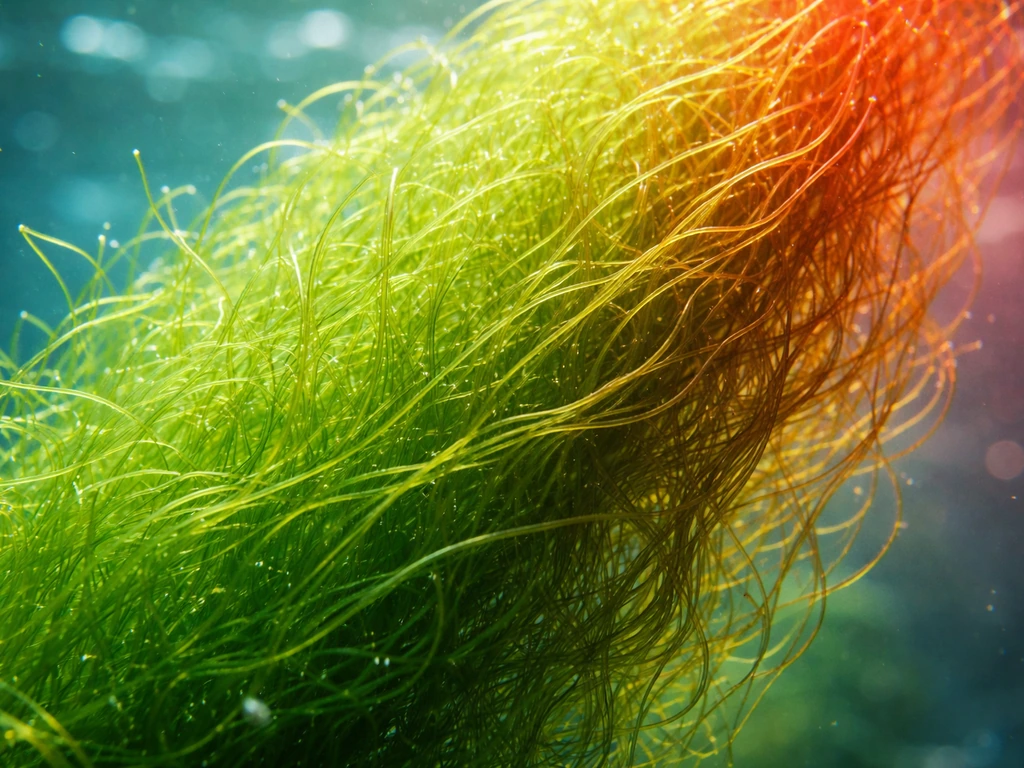
The key absorption bands are blue (around 420–470 nm) and red (around 630–660 nm), those are the wavelengths that chlorophyll actually grabs and uses. Green light in the middle of the spectrum is largely reflected back, which is why chaeto looks green. So when you hear "full-spectrum," know that not all of that spectrum is equally useful; the red and blue ends are doing most of the work.
On the spectrum side, red is especially important for chaeto. Studies on green macroalgae consistently show red wavelengths drive the strongest photosynthetic response. Blue plays a supporting role, it helps with chlorophyll production and supports the microfauna like copepods often living alongside chaeto in a refugium. If your light is heavy in red with a meaningful dose of blue, you're in good shape.
Photoperiod matters too, but there's a bit of nuance. Research on macroalgae shows some species keep benefiting from longer and longer daylengths (up to 24 hours of continuous light), while others hit a saturation point somewhere above 16 hours and stop gaining much from more light time. For chaeto in a refugium context, the practical sweet spot is 12–16 hours of light per day, with at least 8 hours of darkness. Running it indefinitely at 24/7 isn't necessary and can actually stress the alga, it needs that dark period for its metabolic cycles, just like most photosynthesizers.
LED vs fluorescent vs other options
LED wins for chaeto, and it's not particularly close anymore. The reason is simple: purpose-built refugium LEDs can be tuned to emit precisely the wavelengths chaeto uses most, 660 nm deep red and 420–470 nm blue, without wasting energy on the green and yellow bands the alga mostly ignores.
Fiddle leaf figs have their own light needs, but they often benefit from the same general idea of targeting strong, usable spectrum with the right intensity and photoperiod, so it helps to understand whether grow lights are a good fit do fiddle leaf figs like grow lights.
Products like the Finnex refugium LED use a 3:1 ratio of 660 nm red to 460 nm blue, and Innovative Marine's ChaetoMax 9W goes even further with discrete peaks at 420, 470, 630, and 660 nm. That kind of targeted output is hard to match with a traditional fluorescent.
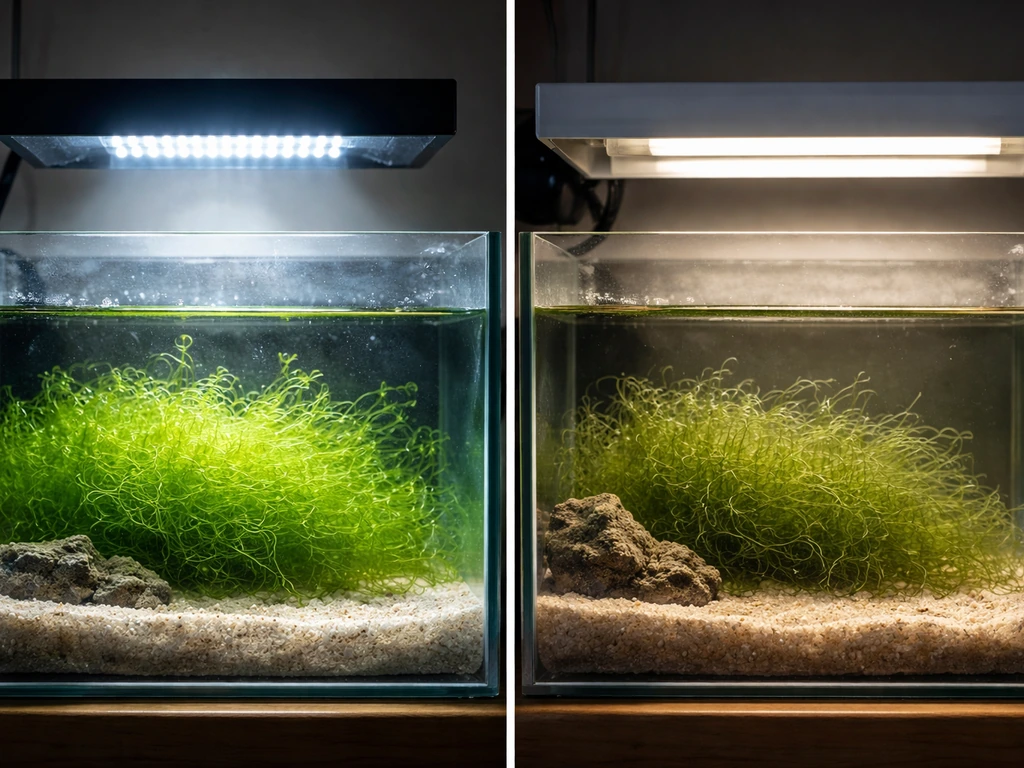
That said, a T5 or T8 fluorescent at 6500K daylight color temperature is a perfectly reasonable budget option, especially if you already have one on hand. Full-spectrum daylight fluorescents cover both the blue and red absorption bands reasonably well, and chaeto will grow under them. The trade-off is efficiency: fluorescents produce more heat and lose significant output as the bulb ages. If you're running a small refugium and don't want to buy specialized gear, a fresh 6500K fluorescent tube works. Just plan to replace it every 6–12 months as the spectrum shifts.
| Light Type | Spectrum Control | Efficiency | Heat Output | Cost | Best For |
|---|---|---|---|---|---|
| Purpose-built refugium LED (e.g., Finnex, ChaetoMax) | Excellent — targeted red/blue peaks | High | Low | $$ | Best overall; fastest chaeto growth |
| Full-spectrum LED (6500K broad-spectrum) | Good — covers blue/red, some wasted middle spectrum | High | Low | $$ | Great all-rounder if you already have one |
| T5/T8 Fluorescent (6500K) | Moderate — full spectrum but not targeted | Moderate | Medium | $ | Budget option; works, needs regular bulb replacement |
| Incandescent / warm white bulb | Poor — too much red/yellow, weak blue | Low | High | $ | Not recommended; too inefficient |
Incandescent and warm-white bulbs aren't worth the trouble. They run hot, eat electricity, and their spectrum skews heavily toward yellow-orange wavelengths that chaeto can't use well. If that's all you have right now, it's worth the modest investment to upgrade.
How much light to target, PAR and PUR explained simply
PAR stands for Photosynthetically Active Radiation, it's measured in PPFD (Photosynthetic Photon Flux Density), expressed as µmol/m²/s. Think of it as the number of light photons hitting your chaeto per second that are in the wavelength range plants can actually use (roughly 400–700 nm). PUR (Photosynthetically Usable Radiation) is a more specific version of that, it only counts the photons that match the actual absorption peaks of the organism in question. A light with high PAR but most of its output in the green band has low PUR for chaeto. That's why targeted red/blue refugium LEDs punch above their wattage.
For chaeto, aim for a PAR of at least 250 µmol/m²/s at the surface of the algae mass. If you want the same kind of targets but for a different plant, see snake plant grow light requirements as a related guide. That's the threshold where most hobbyists report strong, vigorous growth and real nutrient export. You can grow chaeto at lower intensities, moderate intensity in the 100–200 range will sustain it, but growth will be noticeably slower and nutrient-processing capacity drops proportionally. If your main goal is meaningful nitrate and phosphate export, don't underlight.
How to position your light
Mount the light roughly 10–15 cm (about 4–6 inches) above the water surface. For a fiddle leaf fig, you can use the same idea of getting the light close enough to deliver strong intensity without scorching the leaves, then adjust upward or farther as needed where to place grow light for fiddle leaf fig. That distance is the standard recommendation for refugium LEDs and works well for most compact units. If you're using a larger full-spectrum LED designed for a bigger growing area, you may need to raise it a bit to avoid bleaching, more on that in the troubleshooting section.
- Aim the light directly downward onto the chaeto mass — no need for an angled approach.
- If your refugium is wide, a light with a built-in reflector or diffuser helps spread coverage evenly rather than creating a hot spot in the center.
- Keep the light centered over the chaeto mass, not pushed to one side. Uneven lighting means uneven growth, and the shaded portion can start to thin out.
- If you're using a hanging pendant LED, make sure the fixture is stable — chaeto releases gases during photosynthesis and some gentle surface agitation can knock poorly secured lights.
- Avoid placing the light where it will illuminate the main display tank at night if you're running a reverse photoperiod schedule. A baffle or divider between the refugium and sump compartment helps a lot here.
Choosing the right spectrum
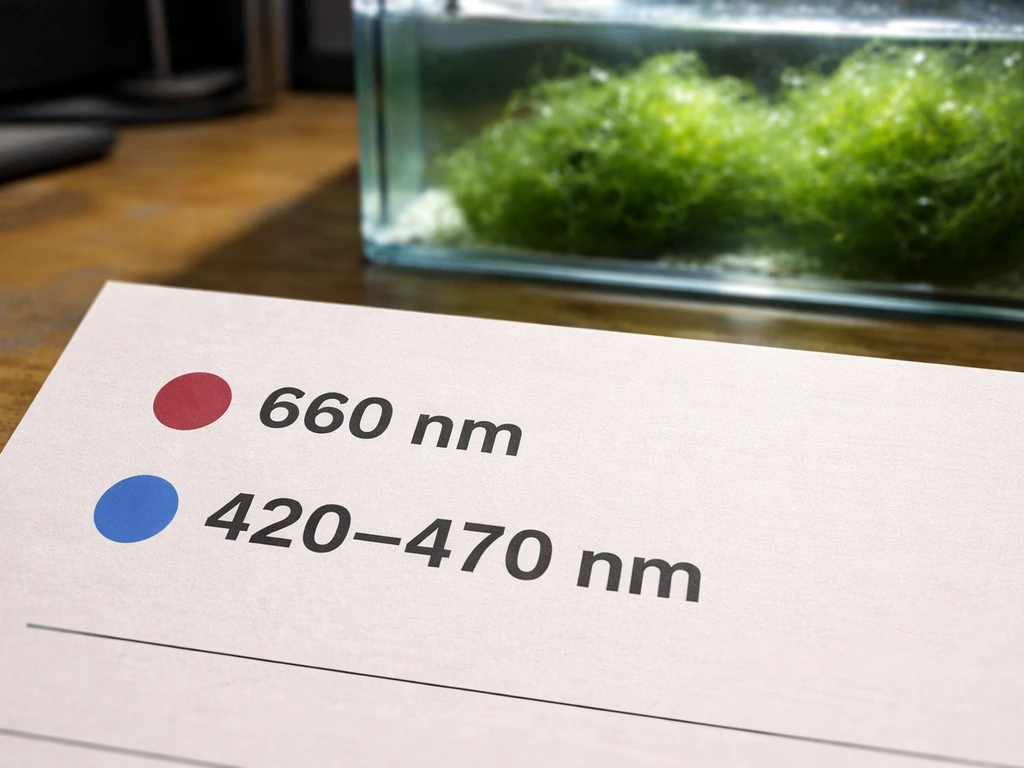
If you're buying a new light specifically for chaeto, look for these wavelength specs on the product label or datasheet: 660 nm deep red and 420–470 nm blue. Some products also include a 630 nm "magenta" peak, which sits just below the primary red absorption band and adds useful photons. A light that hits 660 nm and 450 nm covers the core of what chaeto's chlorophyll is looking for.
If you're shopping for a full-spectrum option rather than a dedicated refugium LED, look for a color temperature of 6500K. Corals have different light needs than chaetomorpha, so you should verify the spectrum and intensity guidance for your specific coral type before you dial in the lighting full-spectrum option rather than a dedicated refugium LED, look for a color temperature of 6500K.
That's the daylight range, and it has a good balance of blue and red energy in the spectrum. Do calatheas like grow lights, and if so, they often prefer similar blue and red balance so you can match the lighting strategy when you grow both plants. Anything below 4000K (warm white) skews too yellow-orange.
Anything above 10000K (the super-blue actinic look popular in reef displays) is heavy in blue but light on red, better for coral photobiology than for macroalgae. Stick with 6500K as your floor if you're going the full-spectrum route. You can use the same general idea for a bonsai tree by choosing a grow light spectrum that provides enough red and blue for photosynthesis.
A beginner-friendly setup plan
Whether you're starting from scratch or just got a new light, don't crank everything to maximum on day one. Chaeto can bleach under a sudden jump in intensity even if the long-term target is the right PAR level. Here's a simple ramp-up plan that works well.
- Week 1: Run the light at 50–60% intensity (or raise it a few inches above the recommended 10–15 cm distance) for 10 hours per day. This lets the chaeto acclimate without stress.
- Week 2: Move the light to its final position (10–15 cm above water) and bump the photoperiod to 12 hours per day. If you have intensity control, bring it to 70–75%.
- Week 3 onward: Run full intensity for 12–16 hours per day. Watch the chaeto for signs of healthy expansion — the clump should visibly grow larger within two to three weeks if conditions are right.
- Schedule: Run the refugium light on a reverse photoperiod — on while your main display lights are off (typically overnight). This helps buffer pH swings because the refugium's photosynthesis consumes CO₂ at night when the display tank's inhabitants are respiring and producing it.
- Harvest: Once the chaeto mass fills roughly two-thirds of your refugium space, manually remove about one-third of the clump. This keeps growth vigorous — a packed, light-blocked mass slows down significantly.
Troubleshooting: slow growth, bleaching, and nuisance algae
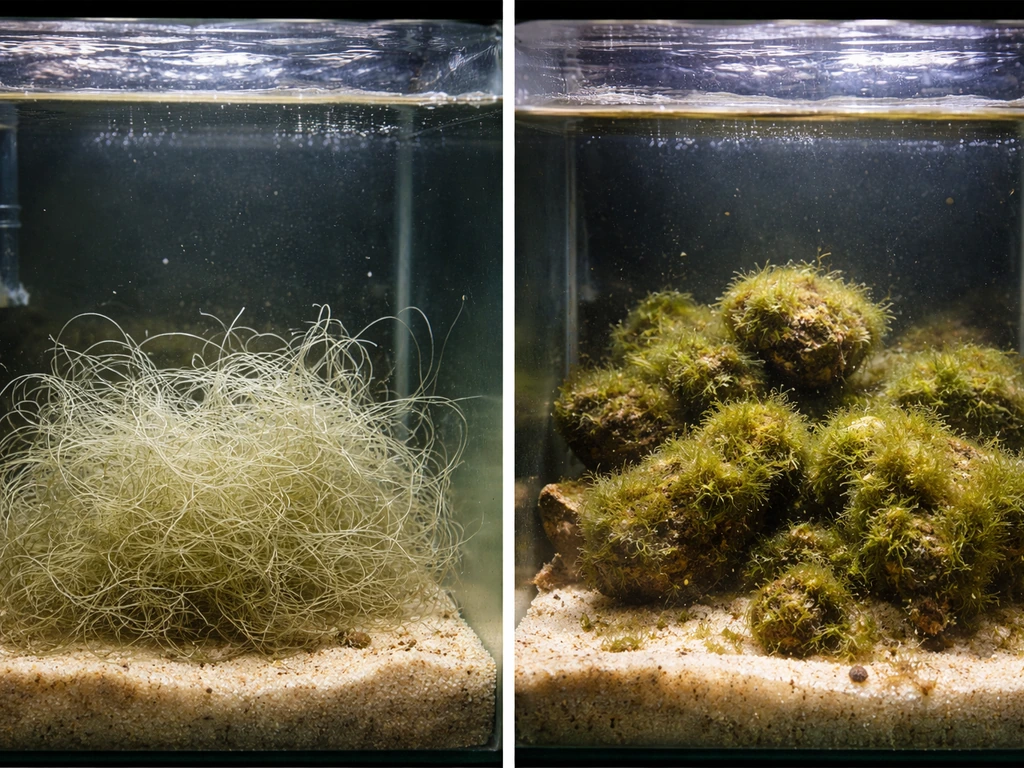
Chaeto growing slowly or barely at all
The most common culprit is insufficient light, followed by insufficient nutrients. First, check your photoperiod, if you're running less than 12 hours, bump it toward 16 hours and give it two weeks to respond. If the photoperiod is already right, consider whether the light is bright enough. For a similar question about what light helps other leafy plants, see do jade plants like grow lights as a related comparison.
A small, low-wattage light positioned too far away won't hit that 250 PAR target. Move it closer or upgrade to a higher-output unit. Finally, check your water chemistry: if nitrates and phosphates are near zero, chaeto has nothing to process and will stall. Paradoxically, pristine water can slow chaeto growth, it needs nutrients to consume.
Chaeto turning pale, brittle, or breaking apart
Pale, brittle chaeto that starts breaking into small fragments is a classic sign that something in its environment isn't meeting its needs. Light deficiency can cause this, but so can spectrum problems. If you're using a warm-white or low-quality bulb, the chaeto may be getting volume of light but not the wavelengths it needs. A bleached, washed-out look (almost white or very light green) that happens quickly points more toward too much light or too much UV, try raising the light 5 cm or dialing back intensity. Gradual paling over weeks usually points to spectrum or nutrient issues instead.
Nuisance algae taking over instead
If you're seeing cyanobacteria, diatoms, or hair algae outcompeting your chaeto, the issue is usually a combination of too much light hitting the wrong surfaces and nutrient imbalance. Nuisance algae that get to nutrients first leave less "fuel" for the chaeto. In a reef context, check flow rates too, chaeto needs good tumbling flow so all parts of the clump get light exposure. Stagnant spots inside a dense chaeto ball go dark and start to decay. If cyano is blooming in the refugium itself, it often means the light is too intense for that specific surface or that there's excess dissolved organic matter, not just nitrate or phosphate.
How to measure intensity without a PAR meter
A dedicated PAR (PPFD) meter is the most accurate tool, but they're expensive and most hobbyists don't own one. The next best option is a smartphone app called Photone (available for iOS and Android). PARwise also highlights why dedicated PAR sensor outputs like PPFD and daily light integral matter when you want to compare measurable light intensity rather than relying only on approximate readings [Photone](https://www. par-wise.
com/). It uses your phone's camera with a small paper diffuser taped over the lens to estimate PPFD more accurately than a basic lux meter app. It's not laboratory-grade, but it gives a meaningful relative reading, enough to compare "is this brighter or dimmer than before? " and to ballpark whether you're in the right zone.
The developer is transparent about its limitations, so use it as a directional tool rather than gospel.
If you don't want to use an app at all, you can work from manufacturer specifications. Most refugium LED products publish a PPFD chart showing intensity at various distances. If the product claims 300 µmol/m²/s at 10 cm, trust that as a rough starting point and adjust based on how your chaeto responds. The biological feedback loop, chaeto getting greener and denser vs. paling and thinning, is genuinely useful as a real-world gauge. Just give each adjustment two to three weeks before judging results, because chaeto responds slowly to changes.
A basic lux meter (many phones have ambient light sensors that free apps can read) can also help compare relative brightness between positions, even if the raw lux-to-PAR conversion isn't perfectly accurate. The conversion factor varies by spectrum, so a warm-white bulb and a 6500K LED will give different PAR readings at the same lux value. But if you're just checking whether moving the light 5 cm closer actually increases intensity at the water surface, a lux comparison gets that done. It's a practical workaround when precision tools aren't in the budget.
FAQ
Can I use a plant light strip or bar, or does it have to be a dedicated refugium LED with specific wavelength peaks?
A strip or bar can work if you can verify it has meaningful output in the 420–470 nm blue range and 630–660 nm red range. If the product only lists “full spectrum” or color temperature without wavelength peaks, expect slower results and be prepared to raise intensity or shorten distance to reach around the 250 µmol/m²/s surface target.
What’s the safest way to ramp up intensity if my chaeto has been under weak light for a while?
Increase either the on-time or the intensity in steps, not both at once. For example, add 2 hours to the photoperiod every few days up to 12–16 hours, then only adjust the height or power after you see color stabilize. If the chaeto starts paling rapidly, back off immediately and keep changes small.
Is 250 µmol/m²/s always ideal, or can too much light hurt chaetomorpha?
Too much light can reduce health and nutrient processing, especially if it spikes suddenly or if the highest intensity is landing on the top of the mat only while the interior goes dark. If you see fast bleaching to near-white, brittleness, or a thin, weak mat even with adequate nutrients, lower intensity or raise the light by a few centimeters and re-check after 2 to 3 weeks.
How does chaeto’s size and density change the lighting requirement?
A dense clump will self-shade, so you may need higher surface intensity than you would for a thinner layer. Aim for strong PPFD at the brightest surface of the chaeto mass, then stir or tumble the clump to ensure the interior receives cycles of light instead of remaining in darkness for long periods.
Should I run the refugium light 24/7 if I’m trying to maximize growth?
Not usually. Many hobby setups see better stability with an 8-hour dark period. Continuous lighting can stress chaeto and shift competition toward nuisance algae in some systems, so keep photoperiod within 12–16 hours for best balance of growth and stability.
Does chaetomorpha need blue and red at equal amounts, or is one more important?
Red is generally the driver for strongest photosynthetic response, blue is supportive. Practical “good enough” performance usually comes from strong red plus a meaningful blue fraction rather than perfect balance. If your light is very blue-heavy (high color temperature) and low on red, expect slower growth unless intensity is increased.
What should I do if my chaeto is growing but nutrient export is still poor?
First confirm you are not underlighting the growth-limiting layer. Then verify nutrients are present, nitrate and phosphate should not be near zero. Also check that the chaeto is actively processed, for example it is being tumbled or the clump shape is not trapping dark interiors, which can reduce uptake efficiency even when biomass increases.
Why do I get cyano or hair algae even though I’m feeding chaeto and lighting it?
Often the issue is mismatch between where nutrients land and where light is delivered. Stagnant zones inside a dense ball can fuel nuisance growth, and nuisance algae can outcompete chaeto if nutrients are available but chaeto is not getting light to the interior. Improve flow and tumbling, and avoid overdriving light onto surfaces that are already causing bleaching.
How close should the light be, and does raising it reduce growth or just prevent bleaching?
For compact refugium LEDs, 10–15 cm is a common starting point. Raising the light reduces surface PPFD, so it can lower growth if you go too far, but it often improves stability by preventing top-layer bleaching. Adjust height in small steps and watch color and thickness over a 2 to 3 week window.
If I use a 6500K fluorescent, how do I know when to replace it?
Replace it when output drops noticeably or about every 6–12 months, especially if you rely on it to hit the PPFD zone. A usable clue is slow thinning or paler chaeto despite the same schedule, which often indicates spectrum and intensity decline rather than a nutrient problem.
Do I need a PAR meter, or can I calculate what I’m getting from specs?
A PAR (PPFD) meter is most accurate, but you can work from manufacturer distance-at-intensity charts if available. If you cannot measure, use directional cues like chaeto color and density response, but wait 2–3 weeks after each adjustment so you do not mistake a temporary lag for a failure.
Can I measure with a phone app like Photone and trust the numbers?
Use it for relative comparisons, not lab-level precision. Make sure you repeat the same setup each time (distance, camera settings if possible, and angle) and compare “before vs after,” for example whether moving the light 5 cm closer actually increases PPFD at the chaeto surface.
Does chaeto need darkness at all, or will it grow fine with just shorter light cycles?
It needs some dark period for metabolic balance in most refugium conditions. If you go below about 12 hours, growth often slows because cumulative energy intake drops, but if you are pushing near the upper intensity limits, a short dark window can also help prevent stress signs.
What’s the simplest troubleshooting sequence when chaeto stops improving?
Check in this order: photoperiod first (target 12–16 hours), then whether PPFD is sufficient at the surface (adjust height or power), then nutrient availability (nitrate and phosphate not essentially zero), and finally physical delivery of light (tumbling, avoiding stagnant interior pockets). After each major change, give it 2 to 3 weeks before deciding it failed.